What is a Morse Code Translator?
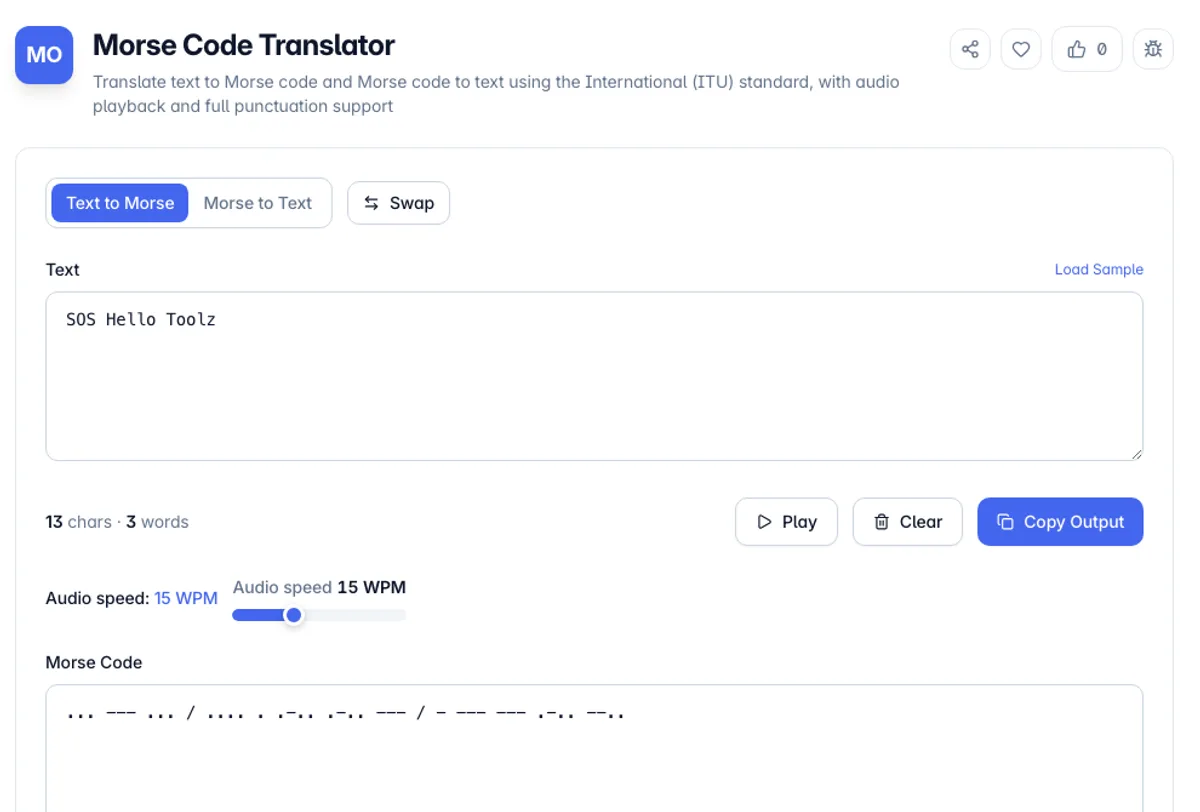
A Morse Code Translator converts ordinary text into Morse code - the dots and dashes used to send messages by sound, light, or radio - and converts Morse code back into readable text. Type "SOS" and you instantly get "... --- ...". Paste those dots and dashes back in and you get "SOS" again. It works with the full International Morse Code alphabet: all 26 letters, the digits 0-9, and the standard punctuation marks such as period, comma, question mark, and slash.
It is also a Morse code audio translator. Type "Call 911" and the output reads -.-. .- .-.. .-.. / ----. .---- .----, since every digit is five symbols long, which is why a Morse code translator for numbers produces longer strings than one for letters. Press Play to hear it as a 600 Hz tone. At the default Audio speed of 15 WPM a dot lasts 80 milliseconds and a dash 240; drag the slider down to 5 WPM for practice or up to 35 WPM for a faster copy.
Morse code represents each character as a unique sequence of short signals (dots, also called "dits") and long signals (dashes, or "dahs"). A single space separates letters and a forward slash separates words, which is the convention this translator follows for output and accepts when decoding. Because the mapping is one-to-one, encoding and decoding round-trip cleanly, so you can verify a message you received or prepare one to send.
Everything runs 100% in your browser. Whether you are learning Morse for an amateur radio license, decoding a signal from a puzzle or game, teaching the alphabet, or just curious what your name sounds like in dots and dashes, nothing you type is uploaded or logged. The translator also plays your Morse as audio beeps at an adjustable speed, and it keeps working offline once the page has loaded.
The International Morse standard is what is used here, which matters because the American variant still turns up in historical material and differs in several letters and most punctuation. Timing is the part that does not survive text: in real Morse a dash is three times the length of a dot, the gap between letters is three dots and between words is seven, and written Morse has to represent those with spacing conventions instead. That is why decoding depends on consistent separators, and why a transcription with irregular spacing can be ambiguous. Prosigns such as SOS are sent as one continuous symbol rather than three letters, so writing them as separate characters changes the meaning even though the dots and dashes look the same.
How to use the Morse Code Translator?
Choose a direction
Pick "Text to Morse" to encode plain text into dots and dashes, or "Morse to Text" to decode a Morse string back into letters and words.
Enter your message
Type or paste your text or Morse code. When decoding, separate letters with spaces and words with a slash or three spaces - the tool accepts either.
Read the live result
The converted output appears instantly below the input, along with a character and word count. Unsupported characters are flagged so nothing silently disappears.
Play or copy
Press Play to hear the Morse as audio beeps at your chosen speed, or copy the output to the clipboard with one click.
Key Features
Two-Way Translation
Encode text to Morse and decode Morse back to text in one tool, switching direction without losing your input
International Standard
Uses ITU International Morse Code for letters, digits, and punctuation, so your output matches what radio operators use
Audio Playback
Hear your message as authentic dot-and-dash beeps with adjustable speed (words per minute) to practice by ear
Flexible Decoding
Accepts words separated by a slash or by extra spaces, and normalizes look-alike dashes and dots so pasted signals still decode
Frequently Asked Questions
Related Tools
Binary Calculator
Add, subtract, multiply, and divide binary numbers, or run AND, OR, XOR, NOT, and bit shifts, with every result shown in binary, octal, decimal, and hex. 100% client-side.
Binary Translator
Translate text to binary and binary to text, plus hexadecimal, decimal, and octal, with full UTF-8 support
IEEE 754 Converter
Convert a decimal number to its IEEE 754 floating-point bits, or decode hex and binary back to a value. Single and double precision, with sign, exponent, and mantissa broken out.
NATO Phonetic Alphabet Translator
Translate text into the NATO phonetic alphabet (Alfa, Bravo, Charlie) and decode code words back to letters
Comments
0 comments
No comments yet. Be the first to share your thoughts!