What is the Percentage Calculator?
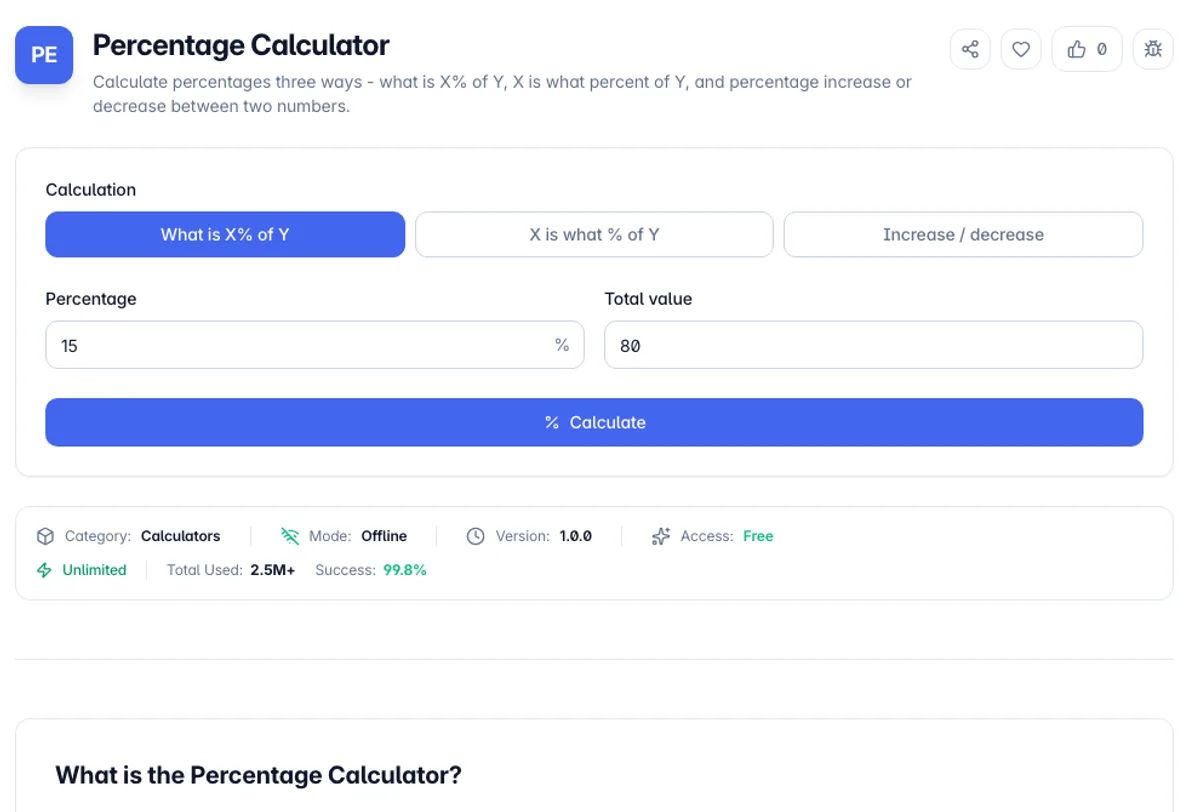
The Percentage Calculator solves the three percentage questions people ask most often: what is X percent of a number, one number is what percent of another, and the percentage increase or decrease between two values. Type your numbers, pick the calculation, and the answer appears instantly along with the exact formula used to reach it.
Percentages trip people up because each question uses a different formula. Finding a tip means multiplying by a percent, working out a discount rate means dividing, and measuring growth means comparing a change against the original amount. This tool keeps the three operations separate and clearly labeled so you always apply the right one - no memorizing formulas, no spreadsheet, no mental arithmetic.
Increase / decrease mode does the same arithmetic whatever the numbers measure, so it works as a percentage increase in salary calculator, a rent increase percentage calculator, or a percentage weight change calculator. A raise from $52,000 to $55,640 is a 7% increase. Rent that goes from $1,500 to $1,575 a month is a 5% increase. A weight change from 180 lb to 171 lb is a 5% decrease. Enter the old figure first and the new figure second, and the formula appears under the answer.
Every calculation runs entirely in your browser. Nothing you type is sent to a server, the tool works offline once the page has loaded, and there is no signup or usage friction. Results are rounded to four decimal places to stay readable while avoiding the floating-point rounding noise that plain JavaScript math often produces.
Two things about percentages trip people up regularly, and both are easy to check here. A percentage increase and the same percentage decrease do not cancel: 100 raised by 10 per cent is 110, and 110 reduced by 10 per cent is 99, because each is taken from a different base. And a change from 20 per cent to 25 per cent is a rise of five percentage points but of 25 per cent, which is why reports that say only "up 25 per cent" are so often misread. The formula is shown with every answer so you can see which base was used. Dividing by zero is caught rather than returning infinity, since a percentage of nothing has no meaningful value.
How to use the Percentage Calculator?
Choose the calculation
Select one of three modes: "What is X% of Y", "X is what % of Y", or "Increase / decrease" for percentage change between two numbers.
Enter your two numbers
Type a value into each field. The labels change to match the selected mode so you always know which number goes where.
Read the result
The answer appears as a plain-English sentence with the numeric result and the formula that produced it, so you can verify or reuse the math.
Copy the answer
Copy the result to your clipboard for a document, invoice, or message, or change the numbers to run another calculation instantly.
Key Features
Three Calculation Modes
Percent of a number, one value as a percent of another, and percentage increase or decrease - the three questions that cover almost every everyday percentage task
Formula Shown With Every Answer
Each result includes the exact arithmetic used, so you can check the math or learn how the calculation works
Increase and Decrease Detection
Change mode automatically labels the result as an increase, decrease, or no change and reports the magnitude clearly
Clean, Accurate Rounding
Results are rounded to four decimals and formatted with thousands separators, avoiding the long floating-point tails raw JavaScript math produces
Frequently Asked Questions
Related Tools
Aspect Ratio Calculator
Calculate the missing width or height for any aspect ratio, simplify a size to its ratio, and scale images or video without distortion.
Average Calculator
Calculate the mean, median, mode, range, and standard deviation of any list of numbers. Paste comma, space, or line-separated values and get every summary statistic at once.
Profit Margin Calculator
Calculate gross profit margin, markup, and selling price from cost and revenue. Solve for price from a target margin and see margin versus markup side by side.
Ratio Calculator
Simplify a ratio to its lowest terms and solve proportions. Reduce values like 1920:1080 to 16:9, or find the missing number in A:B = C:D, with decimals and percentages, all in your browser.
Comments
0 comments
No comments yet. Be the first to share your thoughts!