Defaults to today. Change it to check an age at any past or future date.
What is the Age Calculator?
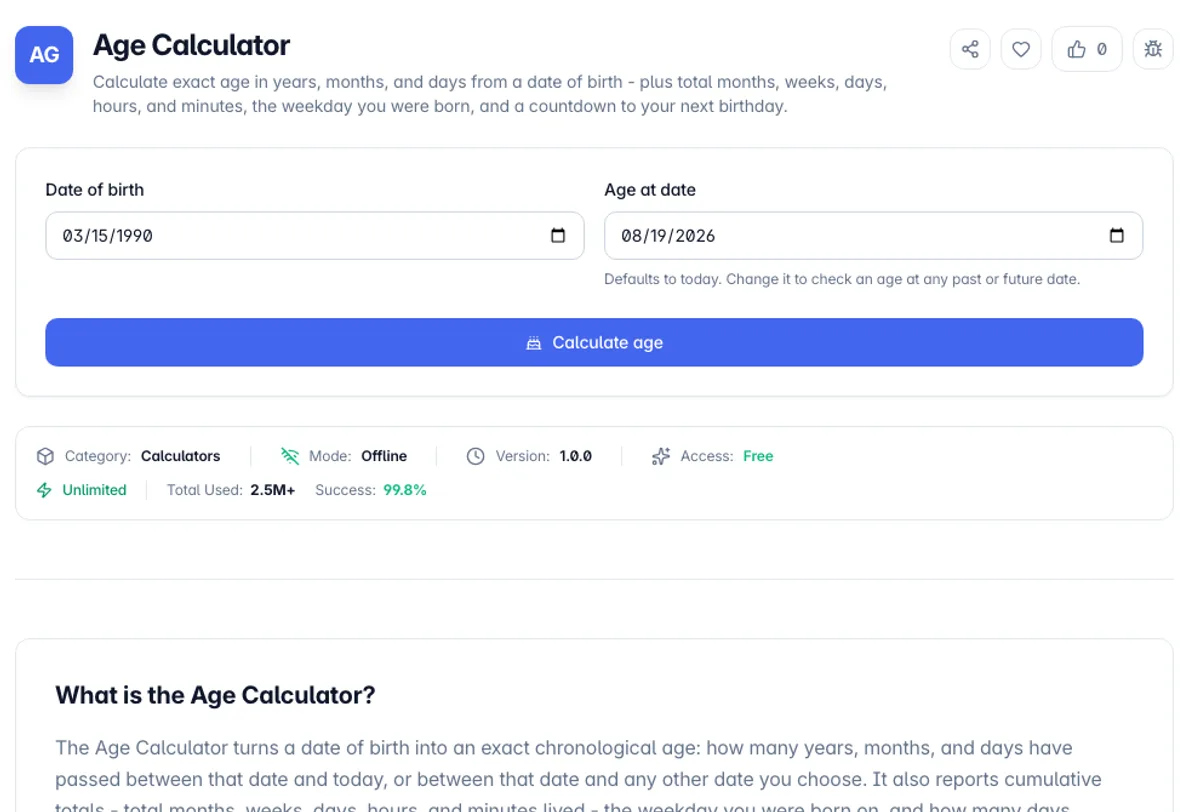
The Age Calculator turns a date of birth into an exact chronological age: how many years, months, and days have passed between that date and today, or between that date and any other date you choose. It also reports cumulative totals - total months, weeks, days, hours, and minutes lived - the weekday you were born on, and how many days remain until your next birthday.
Age arithmetic looks trivial until you try to do it properly. Months have different lengths, leap years insert an extra day roughly every four years, and there is no single answer to "how many days is one month". This calculator borrows days from the actual length of the month preceding the target date rather than assuming a 30-day or 30.44-day average, so the years/months/days breakdown matches the way a calendar actually works and the way registrars, HR systems, and courts count age.
Everything runs in your browser. No date of birth is uploaded, logged, or stored anywhere, which matters because a date of birth is a piece of personal data that identity-theft checks routinely ask for. Once the page has loaded, the tool keeps working with no network connection, and results appear instantly as you change either date.
Age is counted the way people count it, by whole years elapsed, so a birthday later this year has not happened yet and does not count. That makes February the interesting month. Someone born on 29 February has a birthday on a date that exists once every four years, and the common convention, used here, is that they age on 1 March in non-leap years. Month arithmetic carries the same ambiguity as any date difference: the months are counted whole first and the leftover days after, which is why the day figure can look small next to the month figure. Totals in hours and minutes are computed from absolute elapsed time, so they account for the leap days in between rather than assuming 365-day years.
How to use the Age Calculator?
Enter the date of birth
Type or pick the date of birth in the first field. Any calendar date works, including 29 February and dates well over a century in the past.
Set the date to measure to
The second field defaults to today. Change it to calculate age at a past or future date - a policy start date, an exam cut-off, a wedding, or a retirement date.
Read the exact age
The headline shows years, months, and days. Below it you get total months, weeks, days, hours and minutes, the weekday of birth, and the date and weekday of the next birthday with days remaining.
Copy the summary
Copy the full age summary to the clipboard for a form, an email, or a record, or change either date to run another calculation instantly.
Key Features
Calendar-Correct Years, Months, and Days
Days are borrowed from the real length of the preceding month, so the breakdown never drifts the way average-month approximations do
Leap Year and 29 February Handling
Leap days are counted, and a 29 February birthday resolves to 1 March in non-leap years - the convention used by most common-law jurisdictions
Full Totals Breakdown
Total months, weeks, days, hours, and minutes lived, all derived from the exact number of calendar days rather than an average year length
Next Birthday Countdown
Shows the date of the next birthday, the weekday it falls on, the age being turned, and the number of days remaining
Frequently Asked Questions
Related Tools
BMI Calculator
Calculate Body Mass Index from weight and height in metric or imperial units, with the WHO category, your healthy weight range, and the exact formula.
Loan / EMI Calculator
Calculate your monthly loan payment (EMI), total interest, and payoff date, with a full amortization schedule and extra-payment savings.
TDEE Calculator
Calculate your Total Daily Energy Expenditure and BMR with the Mifflin-St Jeor equation, plus calorie targets and a macro split for any goal
Date Difference Calculator
Calculate the exact time between two dates: years, months, days, and business days
Comments
0 comments
No comments yet. Be the first to share your thoughts!