Fill in one dimension and leave the other blank - the calculator solves for the empty field.
What is the Aspect Ratio Calculator?
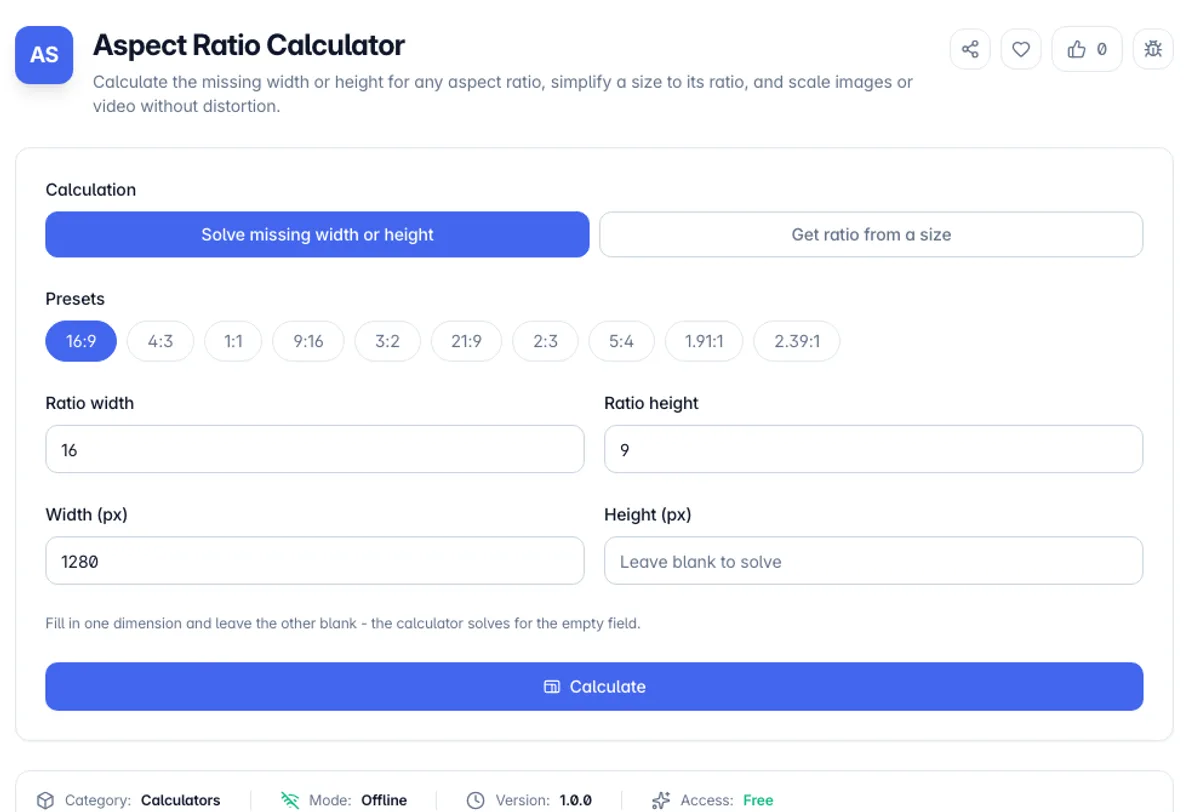
The Aspect Ratio Calculator solves the proportion problem behind every resize. Give it a ratio and one dimension and it returns the other - enter 16:9 and a width of 1280 and it tells you the height is 720. Give it a width and a height and it works backwards, reducing the pair to its simplest integer ratio using the greatest common divisor.
Aspect ratio is the relationship between width and height, written as two numbers separated by a colon. Getting it wrong is what produces stretched faces in a video export, letterboxed bars on a thumbnail, or a hero image that crops badly on mobile. Because the arithmetic is a single division, most people do it in their head and land on a height that is off by a pixel or two - enough for a video encoder to complain or a CSS grid to shift.
The calculator covers the two jobs that come up most: solve for a missing side, and reduce a size to its ratio. Presets cover 16:9, 4:3, 1:1, 9:16, 3:2, 21:9, 1.91:1, and 2.39:1. Every calculation runs in your browser, works offline, and shows the formula it used.
Here is a worked example with the 4:3 aspect ratio calculator setting. Pick the 4:3 preset, type 1024 as the width and leave height blank: the result is 1024 × 768 px, with the formula 1024 × (3 ÷ 4) = 768. Clear the width, enter a height of 1080 instead, and it returns 1440 × 1080 px, or 1.56 MP. The same steps make it a 16:9 aspect ratio calculator, and because every answer is in whole pixels it works as an aspect ratio calculator for images you are about to export or crop.
Rounding is where an aspect ratio calculation goes wrong in practice. Exact ratios rarely produce whole pixels, so a 16:9 width of 1365 gives a height of 767.8125, and rounding that leaves the result slightly off ratio. For images that is invisible. For video it can matter: most H.264 and H.265 encoders require both dimensions to be even, and some require multiples of four, so a computed odd number needs nudging before it will encode. The simplification uses the greatest common divisor, which is why 1920x1080 reduces to 16:9 while 1366x768 reduces to 683:384 rather than to anything recognisable. A size that does not reduce cleanly is usually a sign the source was already cropped off ratio.
How to use the Aspect Ratio Calculator?
Pick a ratio or preset
Choose a preset like 16:9 or 9:16, or type your own ratio into the two ratio fields. The preset only fills the ratio - your dimensions stay put.
Enter the dimension you know
Type the width you need and leave height blank, or the height and leave width blank. The calculator solves for whichever field is empty.
Read the result
You get the completed width × height, the simplified ratio, the decimal ratio, and the exact formula used, plus the megapixel count for image work.
Copy or adjust
Copy the dimensions to your clipboard, or switch to Get ratio from a size to reduce an existing size like 1920 × 1080 down to 16:9.
Key Features
Solve for the Missing Side
Enter a ratio plus a width or a height and get the other dimension instantly, rounded to the nearest whole pixel
Reduce Any Size to Its Ratio
Feed it 1920 × 1080 and get 16:9 back. The reduction uses the greatest common divisor, and decimal ratios like 1.91:1 are handled by scaling before reduction
Ten Built-In Presets
16:9, 4:3, 1:1, 9:16, 3:2, 2:3, 5:4, 21:9, 1.91:1 for Open Graph images, and 2.39:1 anamorphic - each labelled with where it is used
Formula Shown With Every Answer
The exact arithmetic appears under the result, so you can verify the maths or reuse it in a spreadsheet or script
Frequently Asked Questions
Related Tools
Discount Calculator
Work out the sale price and money saved from a percentage or fixed discount, stack an extra coupon, and add sales tax - with the effective discount shown.
Fraction Calculator
Add, subtract, multiply, and divide fractions online - with whole numbers, mixed numbers, and decimals, reduced to lowest terms with step-by-step working
Percentage Calculator
Calculate percentages three ways - what is X% of Y, X is what percent of Y, and percentage increase or decrease between two numbers.
Ratio Calculator
Simplify a ratio to its lowest terms and solve proportions. Reduce values like 1920:1080 to 16:9, or find the missing number in A:B = C:D, with decimals and percentages, all in your browser.
Comments
0 comments
No comments yet. Be the first to share your thoughts!