| Name | Min/Max | Limit | Type | Current Status |
|---|---|---|---|---|
| Meta Title | Max | 55 | Letter | Pass |
| Meta Description | Max | 160 | Letter | Pass |
| Google Ideal Post Content | Min | 300 | Word | Fail |
| Instagram Captions/Comments | Max | 2,200 | Letter | Pass |
| Twitter Post | Max | 280 | Letter | Pass |
| Twitter Username | Max | 20 | Letter | Pass |
| Facebook Wall Post (Truncation) | Max | 477 | Letter | Pass |
| Facebook Wall Post (All) | Max | 63,206 | Letter | Pass |
| Facebook Comment | Max | 8,000 | Letter | Pass |
| Facebook Page Description | Max | 255 | Letter | Pass |
| Facebook Username | Max | 50 | Letter | Pass |
| Facebook Messenger Message | Max | 20,000 | Letter | Pass |
| YouTube Video Title | Max | 70 | Letter | Pass |
| YouTube Video Description | Max | 5,000 | Letter | Pass |
| Snapchat Caption | Max | 250 | Letter | Pass |
| Pinterest Pin Description | Max | 500 | Letter | Pass |
| LinkedIn Post | Max | 3,000 | Letter | Pass |
| LinkedIn Article | Max | 120,000 | Letter | Pass |
| TikTok Caption | Max | 2,200 | Letter | Pass |
| TikTok Bio | Max | 80 | Letter | Pass |
What is the Word Counter?
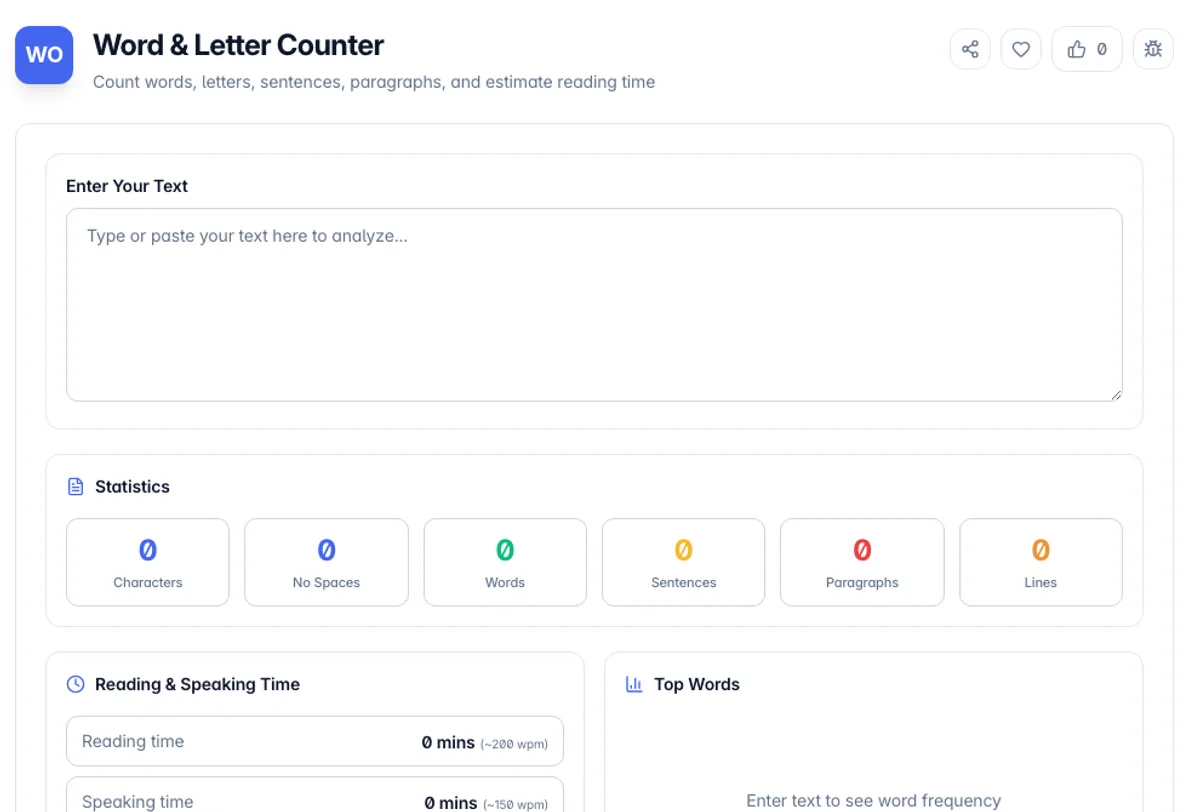
The Word Counter is a free online tool that provides detailed text statistics including word count, character count (with and without spaces), sentence count, paragraph count, and estimated reading time. It is an essential tool for writers, students, bloggers, and anyone who needs to track text length.
Whether you are writing an essay with a specific word limit, crafting a tweet within character constraints, or preparing content that needs to fit a particular reading time, this tool gives you instant and accurate statistics. It updates in real-time as you type, so you always know exactly where you stand.
The tool processes everything locally in your browser, ensuring your writing remains private. It handles text in any language and works with content of any length, from a single sentence to an entire manuscript. No sign-up or installation required.
The same rule, a word is anything between spaces, makes it a personal statement word counter, a Spanish word counter or a Bible word counter without any settings. Paste Genesis 1:1 from the King James Version, "In the beginning God created the heaven and the earth.", and it reports 10 words and 54 characters. Copy the verse with its number in front and the total becomes 11 words, because the number sits between spaces too. A word counter for Chinese characters is the exception: there, read Characters, since Chinese puts no spaces between words.
What counts as a word is a convention rather than a fact, and the convention here is a run of characters between whitespace. That matches how word processors count and how most editors and publishers specify a limit, so the number lines up with an assignment brief or a submission guideline. It also means it does not translate to every language: Chinese, Japanese and Thai are written without spaces between words, so a passage in those scripts counts as very few words and a great many characters. Use the character count there instead. Reading time assumes around 200 to 250 words a minute, which is a reasonable average for adults reading non-technical prose, and is optimistic for dense technical material that people re-read. Hyphenated compounds count as one word.
Converting characters to words gives an estimate rather than an exact figure. An English word averages a little under five letters (4.79 in Peter Norvig's count of the Google Books corpus), and each word also brings a space and the odd comma, so ordinary prose runs at about six characters per word with spaces and five without. That puts 300 characters at roughly 50 words, 1,000 characters at about 170 words, and 3,000 characters at about 500 words when the limit counts spaces. Technical writing with long terms fits fewer words into the same space, and the Avg. word length figure under the counter shows the ratio for your own text. If you came here for a letter counter, read the No Spaces total. It counts every visible character, digits and punctuation included, and the Character Counter checks that same text against platform length limits.
How to use the Word Counter?
Enter your text
Paste or type your text into the input area. You can add content of any length, from a few words to thousands of paragraphs.
View live statistics
As you type, the tool instantly displays word count, character count, sentence count, paragraph count, and estimated reading time.
Check specific metrics
Review individual metrics like characters with spaces, characters without spaces, average word length, and more detailed breakdowns.
Use the insights
Use the statistics to ensure your content meets word limits, character restrictions, or reading time targets for your specific needs.
Key Features
Counts What You See
Characters are counted as grapheme clusters, so an emoji counts as one rather than as the two or more storage units it occupies
Real-Time Counting
Statistics update instantly as you type, giving you immediate feedback on your text metrics
Reading Time Estimate
Calculates estimated reading time based on average reading speed, perfect for blog posts and articles
Comprehensive Statistics
Counts words, characters (with/without spaces), sentences, paragraphs, and average word length
Frequently Asked Questions
Related Tools
Character Counter
Count characters, words, sentences and paragraphs live as you type, estimate reading time and byte size, and check your text against social media and SEO length limits.
String Reverse
Reverse any text string instantly. Supports file upload and URL loading with auto-reverse option.
Text Diff Checker
Compare two texts and find differences. Highlight additions, removals, and common parts with word or character level comparison.
Word Frequency Counter
Count how often each word appears in your text and rank the results by frequency. Filter stop words, set a minimum length, and copy the table. Client-side, no signup.
Comments
0 comments
No comments yet. Be the first to share your thoughts!