What is the Compare Two Lists tool?
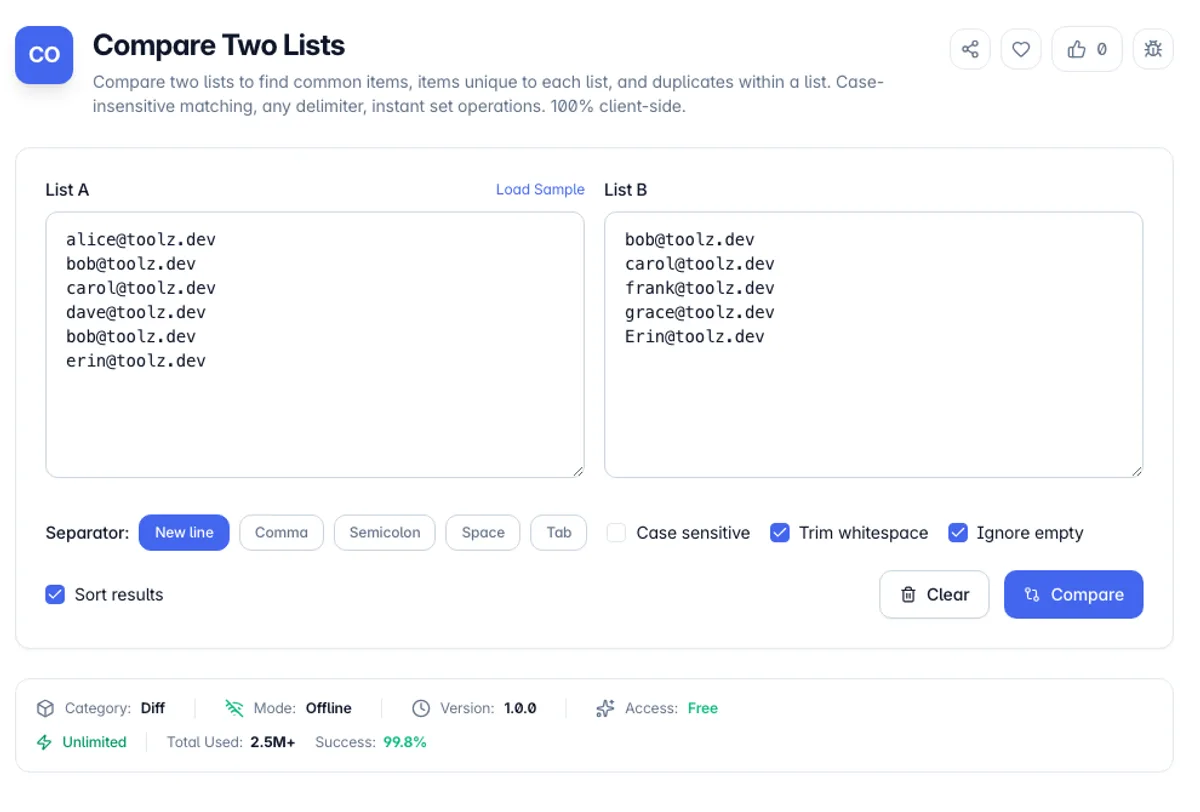
Compare Two Lists takes two lists of items - email addresses, SKUs, usernames, IDs, URLs, anything one-per-line - and answers the membership questions you have about them: which items appear in both, which are only in the first, which are only in the second, and which are duplicated within a single list. It is set arithmetic with a UI, running instantly on lists of thousands of items.
You can check how it works to compare two lists online in a few seconds. Click Load Sample, then Compare. List A has six email addresses and List B has five. In Both shows bob, carol and erin, because [email protected] in List B matches [email protected] in List A when case is ignored. Only in A shows alice and dave, Only in B shows frank and grace, and Duplicates in A shows bob, who is listed twice. That is how to compare two lists for differences without losing the repeats.
This is not a line-by-line diff. A diff cares about order and position, so moving one line makes everything below it look changed. This tool treats each list as an unordered bag of items, which is the right model when you are reconciling an export from one system against an export from another. Row 300 in your CRM export has no relationship to row 300 in your billing export; the only thing that matters is whether the value exists on both sides. If you want a positional, side-by-side comparison of prose or code, use the Text Diff Checker instead.
Everything runs in your browser. That matters more here than for most utilities, because the lists people compare are usually the sensitive kind - customer emails, employee IDs, license keys, account numbers. Nothing is uploaded, so pasting a subscriber export into this page carries none of the risk of pasting it into a service that processes it server-side.
The comparison is set-based, so an item appearing three times in one list is one member of that set. That is why duplicates within each list are reported separately rather than folded into the result: knowing that a list has repeats is usually as useful as knowing what the two lists share. Case-insensitive matching compares in a normalised form while preserving what you typed in the output.
How to use the Compare Two Lists tool?
Paste your two lists
Put one list in List A and the other in List B. One item per line is the default; load the sample if you want to see how duplicates and case differences are reported.
Choose how items are separated
Switch the Separator from New line to Comma, Semicolon, Space or Tab if your data is not one-per-line. A single CSV column pasted straight from a spreadsheet is usually newline-separated already.
Set the matching rules
Decide whether case matters, whether to trim surrounding whitespace, and whether to skip blank entries. Case-insensitive matching with trimming is the sensible default for emails and identifiers.
Compare and export the result
Press Compare, then open any result group - In Both, Only in A, Only in B, Unique, All (Union), Duplicates - and copy it or download it as a .txt file. Copy Report puts In Both, Only in A, Only in B and both duplicate groups into one text summary.
Key Features
Every set operation at once
One comparison gives you intersection, both differences, the symmetric difference and the union - no need to re-run the tool with a different mode selected for each question.
Duplicate detection within each list
Items repeated inside a single list are reported separately from cross-list matches, which catches the double-entry problem that causes duplicate sends and double-billing.
Case-insensitive matching that preserves your data
Fold case for matching so Erin@ and erin@ count as one item, while the output still shows the original casing exactly as you pasted it rather than a lowercased copy.
Any delimiter
Newline, comma, semicolon, space or tab. Paste a spreadsheet column, a CSV row or a space-separated shell output without reformatting it first.
Frequently Asked Questions
Related Tools
CSV Diff Checker
Compare two CSV files and see which rows were added, removed, or changed, down to the exact cell. Match rows by a key column or by position. Runs client-side.
JSON Diff Checker
Compare two JSON documents structurally and see added, removed, and changed keys with exact paths
XML Diff Checker
Compare two XML documents structurally and see which elements, attributes, and text values were added, removed, or changed, by node path rather than by line. 100% client-side.
String Reverse
Reverse any text string instantly. Supports file upload and URL loading with auto-reverse option.
Comments
0 comments
No comments yet. Be the first to share your thoughts!