- [What's new](#whats-new)
  - [Upgrade steps](#upgrade-steps)
What is the Markdown to HTML Converter?
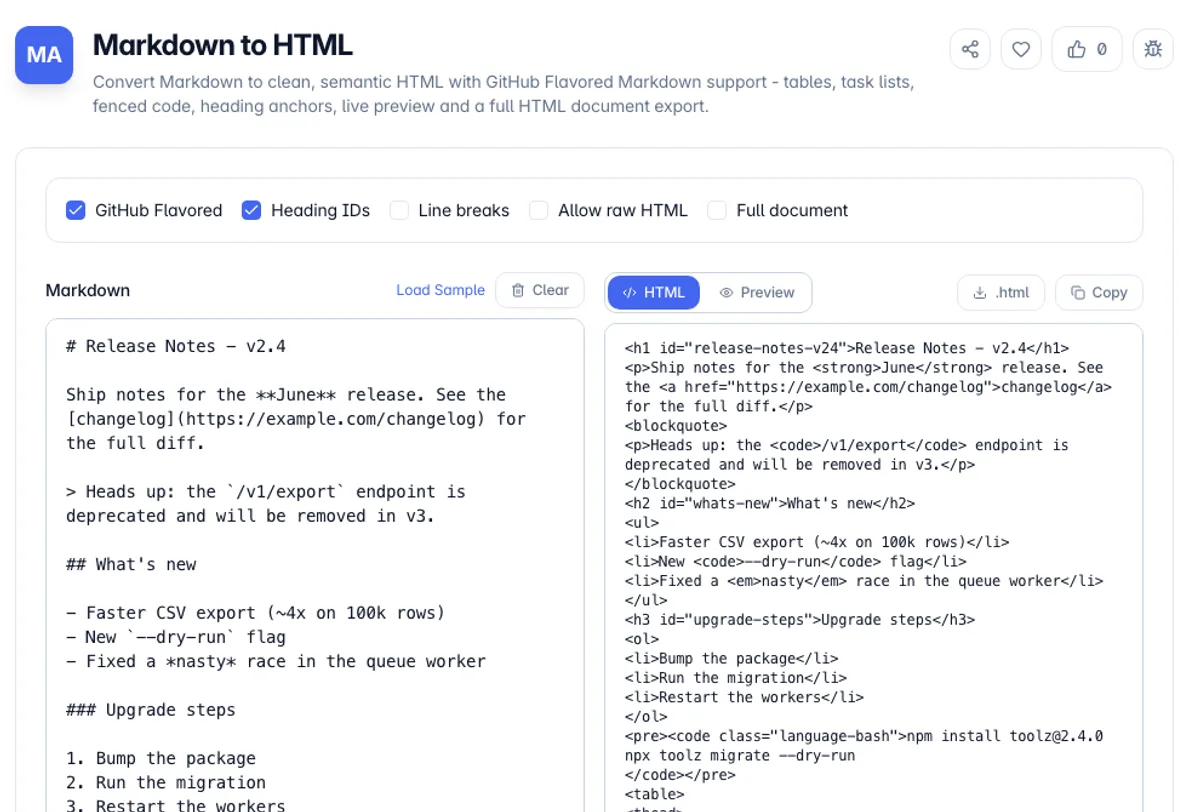
The Markdown to HTML Converter turns Markdown source - a README, a changelog, a blog draft, a set of release notes - into the HTML a browser or CMS renders. Paste or type Markdown on the left, and you get semantic HTML on the right: headings become h1–h6, fenced code becomes pre and code with a language class, lists become ul and ol, and GitHub extensions such as tables, task lists and strikethrough are handled the way GitHub renders them.
Markdown is a plain-text writing format, not a display format. Anywhere it appears on a page - a docs site, a static blog, an email template, a CMS field that only accepts HTML - something has to compile it first. Doing that in the browser, rather than pulling a parser into your build or pasting your draft into a service you do not control, is the fastest way to get the markup out and move on.
Everything runs client-side. The converter is a hand-written parser, not a wrapper around a remote API, so your unpublished posts, internal docs and private release notes never leave the page. Toggle GitHub Flavored Markdown, heading anchor IDs, single-newline line breaks and raw HTML pass-through, then copy the HTML, download an .html file, or grab a generated table of contents.
A short worked example shows what you get when you convert Markdown to HTML here. Paste `# My Project`, then `## Install`, then a two-row task list `- [x] Done` and `- [ ] Todo`. The output is `<h1 id="my-project">My Project</h1>`, `<h2 id="install">Install</h2>` and a `<ul class="task-list">` whose items start with disabled checkbox inputs. Tick Full document and the same body is wrapped in a doctype with `<title>My Project</title>`. It is a free Markdown to HTML converter, no signup, and it converts as you type.
Markdown permits raw HTML inline, which makes the safety question real rather than theoretical: a document containing a script tag is valid Markdown, and a converter that passes it through produces HTML that will run when rendered. Output here is escaped by default for that reason, so a Markdown file from an untrusted source cannot smuggle tags into your page. Links are a separate case: a `javascript:` link in the Markdown keeps that href in the copied HTML, and only the preview pane rewrites it, so sanitise the output before publishing Markdown you did not write. If you are converting your own content and want raw HTML preserved, that is a deliberate choice rather than the default. The other thing to know is that Markdown has no single specification. GitHub Flavored Markdown is implemented here, which covers tables, task lists, strikethrough and fenced code, and those are extensions rather than part of the original syntax, so a strict CommonMark renderer will not show them.
How to use the Markdown to HTML Converter?
Paste your Markdown
Type or paste Markdown into the editor - a README, a changelog, notes from your editor, anything. The output updates as you type; load the sample if you want to see what is supported.
Choose your options
Turn GitHub Flavored Markdown on for tables, task lists, strikethrough and bare-URL links. Add heading IDs for deep links, enable line breaks if a single newline should become a <br />, and allow raw HTML if your Markdown already contains tags.
Check the preview
Switch between the HTML source and a rendered preview to confirm the structure is what you expected, and read the document stats - words, headings, links, code blocks and reading time.
Copy, download or take the TOC
Copy the HTML to the clipboard, or press .html to download it as document.html (tick Full document first if you want a standalone page). You can also copy the auto-generated Markdown table of contents built from the H2 and H3 heading anchors.
Key Features
GitHub Flavored Markdown
Tables with column alignment, task list checkboxes, ~~strikethrough~~ and automatic linking of bare URLs - the extensions your README already relies on
Fenced Code with Language Classes
Fenced blocks become <pre><code class="language-js">, the class name Prism, highlight.js and Shiki expect, so syntax highlighting works the moment you paste the output into your site
Heading Anchors and TOC
Every heading gets a slugified, de-duplicated id, and the tool generates a Markdown table of contents for your H2 and H3 headings that you can paste back at the top of your document
Safe by Default
Raw HTML in the source is escaped unless you opt in, and the live preview strips script, style and inline event handlers - so pasting someone else’s Markdown cannot run their code
Frequently Asked Questions
Related Tools
HTML Formatter
Format, beautify, and minify HTML online. Re-indents messy or minified markup, keeps script, style, and pre content verbatim, and runs entirely in your browser.
HTML to Markdown
Convert HTML to clean Markdown instantly. Turns headings, lists, links, images, blockquotes, code blocks and tables into portable GitHub Flavored Markdown. Tolerant of messy CMS markup. Runs client-side.
Markdown Table Generator
Build Markdown tables in a spreadsheet-style editor - import CSV, Excel, or an existing table, set alignment, copy clean GFM
Markdown TOC Generator
Generate a linked table of contents from Markdown headings
Comments
0 comments
No comments yet. Be the first to share your thoughts!