What is Date Difference Calculator?
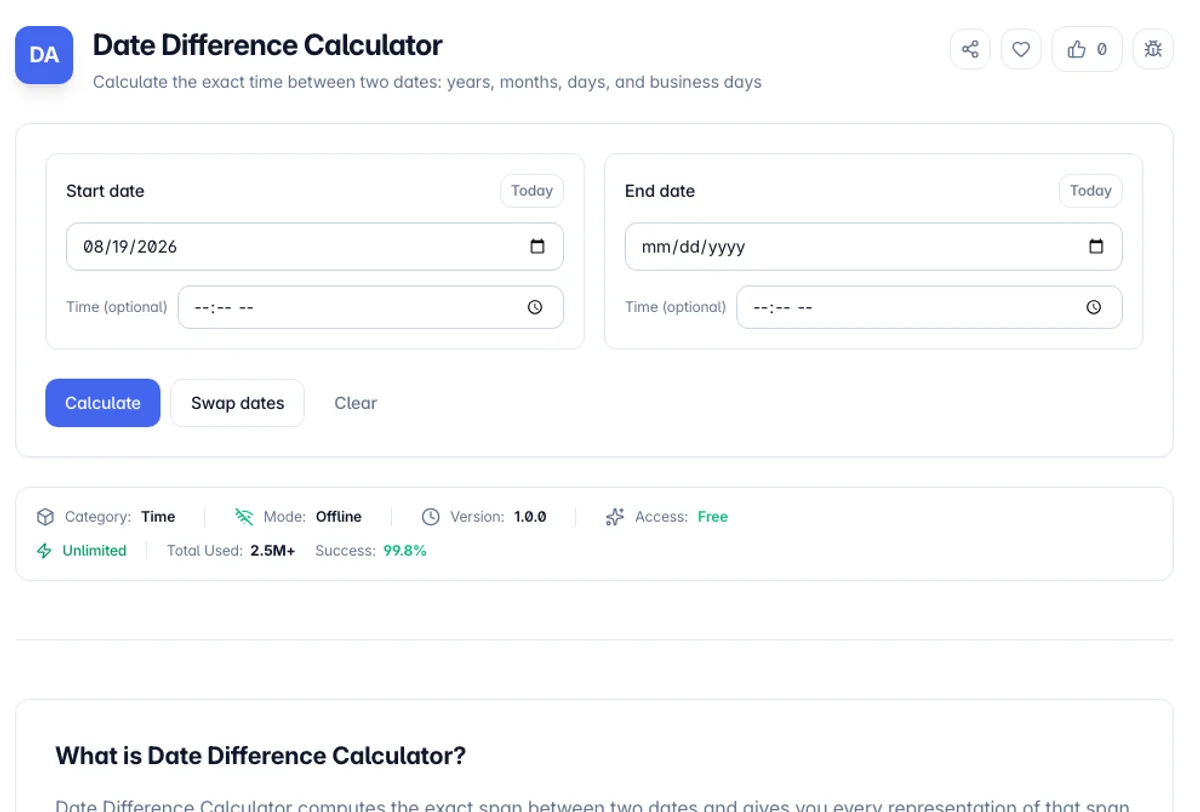
Date Difference Calculator computes the exact span between two dates and gives you every representation of that span at once: a calendar breakdown (X years, Y months, Z days), running totals (total days, weeks, hours and minutes), and a business-day count that excludes Saturdays and Sundays. Add optional times to either date when you need hour-level precision - useful for measuring incident durations, SLA windows, or deployment gaps.
Date math is deceptively hard to get right in code. Naive implementations that subtract timestamps and divide by 86400000 break the moment a daylight-saving transition lands inside the range, producing off-by-one-day answers twice a year. This calculator parses both dates as UTC and does the calendar breakdown with proper month-length borrowing (28/29/30/31 days), so "Jan 31 to Mar 1" and leap-year February are handled correctly - the same logic you would want in a well-tested date library, without pulling one into your project just to answer a quick question.
A worked example shows what the date calculator difference returns. Set Start date to 2026-09-14, End date to 2026-12-25 and click Calculate: the Difference line reads 0 years, 3 months, 11 days, Total days shows 102, Total weeks 14, and Business days (Mon-Fri, inclusive) shows 75 with 28 weekend days excluded. Fill in both Time (optional) fields and it works as a date time difference calculator: 2026-03-02 09:30 to 2026-03-06 17:15 gives 4 days, 103 total hours and 6,225 total minutes.
Everything runs client-side: the dates you enter are never sent to a server, and the tool works offline. Typical developer uses include computing sprint lengths, certificate and token expiry windows, data-retention cutoffs, contract notice periods, age calculations, and the classic "how many working days until the release?" - with swap and Today shortcuts so you spend seconds on it, not minutes.
Two parts of date arithmetic are ambiguous rather than difficult, and it helps to know which answer you are getting. Adding a month to 31 January has no correct result, so calendar differences walk whole months from the start date, clamping to the last day of a short month, and then count the remaining days. That is why 31 January to 28 February reads as 1 month, 0 days in 2023 but 0 months, 28 days in 2024, when February runs to the 29th. Daylight saving is the other one: the tool has no time zones and treats both times as plain clock readings, so 01:00 to 03:00 on the night the clocks spring forward reads as 2 hours even though only 1 hour passed. The business-day count excludes Saturdays and Sundays only. It has no holiday calendar, so a span crossing Christmas or a national holiday will read high for payroll or delivery estimates.
How to use Date Difference Calculator?
Pick the start and end dates
Use the two date pickers to set your range, or click a Today button to snap either side to the current date. Enter dates in any order - the calculator handles reversed ranges.
Add times if you need precision
Optionally fill in the Time (optional) field (HH:mm) for either date. This refines the day breakdown and makes the total hours and minutes exact instead of midnight-to-midnight.
Calculate
Click Calculate to get the calendar breakdown (years, months, days), the totals grid, and the business-day count. Use Swap dates to flip start and end instantly.
Read the results
The breakdown answers "how long in human terms", the totals answer "how many units exactly", and business days (Mon-Fri, endpoints included) answers scheduling questions like working days until a deadline.
Key Features
Calendar Breakdown
Exact years, months, and days between dates with correct month-length borrowing and leap-year handling
Totals Grid
The same span as total days, weeks, hours, and minutes - pick the unit your problem needs
Business Days Count
Working days (Mon-Fri) between the two dates with weekends excluded, endpoints included
Optional Time Precision
Add HH:mm to either date to measure durations to the minute, not just whole days
Frequently Asked Questions
Related Tools
Cron Expression Generator
Build a cron expression from simple fields or presets, see it explained in plain English, and preview the next run times. Supports lists, ranges, steps, named months and weekdays. Runs client-side.
Cron Expression Parser
Parse cron expressions into plain English and preview upcoming run times
Time Duration Calculator
Calculate the duration between two times, add or subtract hours and minutes from a time, and total a list of durations for timesheets.
Age Calculator
Calculate exact age in years, months, and days from a date of birth - plus total months, weeks, days, hours, and minutes, the weekday you were born, and a countdown to your next birthday.
Comments
0 comments
No comments yet. Be the first to share your thoughts!