30 9 * * 1-5At 09:30 on Monday, Tuesday, Wednesday, Thursday, and Friday (UTC).
What is the Cron Expression Generator?
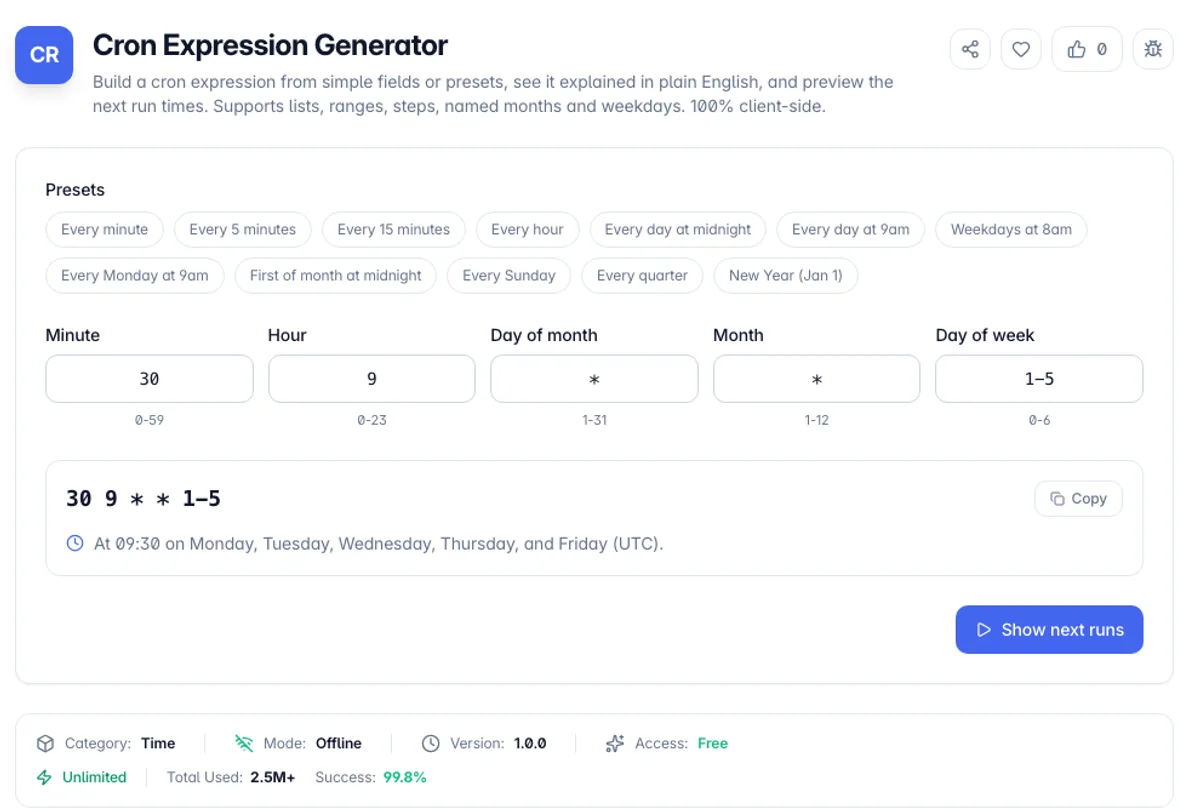
The Cron Expression Generator turns a schedule you have in your head - "every weekday at 8am", "the first of the month at midnight", "every fifteen minutes" - into the five-field cron expression a scheduler understands. You set the minute, hour, day of month, month and day of week, or start from a preset, and the tool assembles the expression, explains it in plain English, and shows you exactly when it will next fire. It closes the gap between what you want to happen and the terse syntax that makes it happen.
Cron syntax is compact and unforgiving. `0 0 * * 0` runs every Sunday at midnight, while `0 0 0 0 0` is not a schedule at all: day of month starts at 1 and month starts at 1, so the tool rejects it with "day of month value out of range (1-31)". The day-of-month and day-of-week fields interact in a way that surprises almost everyone the first time. Writing an expression by hand and hoping it is right is how a backup ends up running once a year instead of once a night. Building it here, with a live description and a preview of upcoming run times, lets you confirm the schedule before it reaches your crontab.
The expression is built, validated, described and simulated client-side, with no account needed. When you press Show next runs, the page makes a usage check and logs a usage record that includes the expression, so treat the schedule string as something that leaves the page. Copy the finished expression straight into a crontab, a CI pipeline, a Kubernetes CronJob, or any scheduler that speaks standard cron.
As a cron job expression generator, it works from the schedule you want. Say a backup should run at 2am every Sunday: set Minute to 0, Hour to 2 and Day of week to 0, leave the other two fields as *, and the expression reads `0 2 * * 0` with the line "At 02:00 on Sunday (UTC)." Press Show next runs on Monday 14 September 2026 and the first entry is Sun, 20 Sep 2026 02:00 UTC, followed by the next five Sundays. That preview is how a free cron expression generator earns its keep: you see the real dates before the job is deployed.
Validation catches the syntax errors, but it cannot catch the logical ones, and the common logical error is the day-of-month and day-of-week rule: when both are set, cron runs on either match rather than both. The plain-English line does not show this, since `0 0 13 * 5` reads "on the 13th of the month on Friday", but the next run list does: it includes every Friday as well as Tuesday 13 October. Check the run list before trusting a schedule.
How to use the Cron Expression Generator?
Start from a preset or blank
Pick a common schedule like "Weekdays at 8am" to load its fields, or start from every-minute and adjust. Presets are the fastest way to a working expression.
Set the five fields
Enter minute, hour, day of month, month and day of week. Each field accepts a value, a list (1,15), a range (1-5), a step (*/10) or * for every.
Read the plain-English description
The tool describes the schedule as you type, for example "At 08:00 on Monday, Tuesday, Wednesday, Thursday, and Friday (UTC).", so you can confirm it matches your intent before trusting it.
Check the next runs and copy
Press Show next runs to list the next six run times in UTC and catch mistakes like an impossible date, then press Copy and paste the expression into your scheduler.
Key Features
Field builder with full syntax
Every field accepts single values, comma lists, hyphen ranges and step values, plus named months (JAN-DEC) and weekdays (SUN-SAT), so you can express any standard schedule.
Plain-English explanation
The generator renders your expression as a sentence, turning cryptic asterisks and slashes into a schedule you can read and sanity-check at a glance.
Next run preview
See the next six dates and times the job will fire, computed in UTC. Nothing catches a broken expression faster than seeing it would run in three months instead of tonight.
Ready-made presets
One click loads common schedules - every 5 minutes, hourly, daily at midnight, weekdays at 8am, first of the month - as a starting point you can then tweak.
Frequently Asked Questions
Related Tools
Cron Expression Parser
Parse cron expressions into plain English and preview upcoming run times
Date Difference Calculator
Calculate the exact time between two dates: years, months, days, and business days
Time Duration Calculator
Calculate the duration between two times, add or subtract hours and minutes from a time, and total a list of durations for timesheets.
Timestamp Converter
Convert between Unix timestamps and human-readable dates
Comments
0 comments
No comments yet. Be the first to share your thoughts!