Current Time
Timestamp → Date
Date → Timestamp
What is Timestamp Converter?
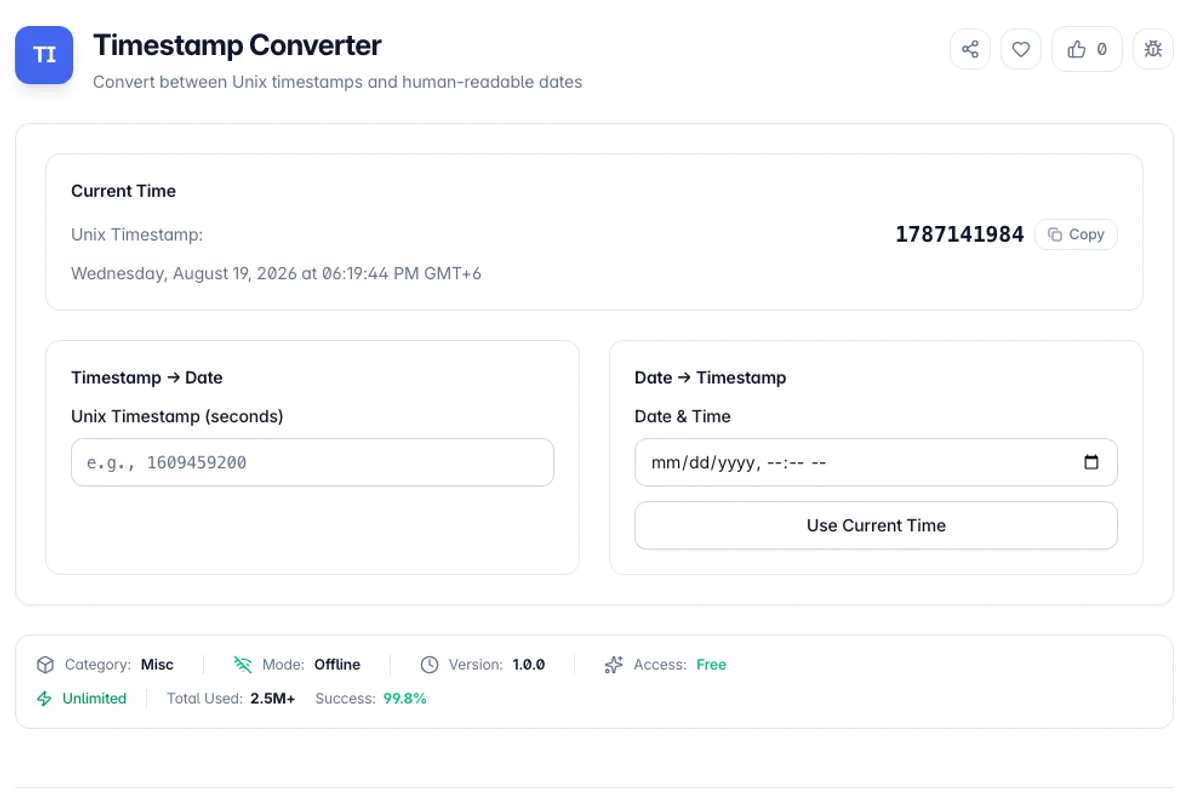
Timestamp Converter is a free online tool that converts between Unix timestamps (epoch time) and human-readable date formats. Unix timestamps represent the number of seconds (or milliseconds) elapsed since January 1, 1970 UTC, and are widely used in programming, databases, and APIs for storing and transmitting date and time information.
The tool supports conversion in both directions: enter a Unix timestamp to see the corresponding date and time, or enter a date to get the Unix timestamp. A timestamp is shown as ISO 8601, a human-readable date in your local time zone, a UTC line and relative time (e.g., "2 hours ago"); a date is shown as Unix seconds, milliseconds and ISO 8601.
Whether you are a developer debugging API responses, a system administrator analyzing log files, or anyone working with timestamps in code, this tool gives instant conversions. It reads timestamps in seconds, returns both seconds and milliseconds when you convert a date, and shows the current Unix timestamp ticking in real time.
Here is the Unix timestamp to date converter at work. Type 1609459200 into Unix Timestamp (seconds) and the panel shows ISO 8601 2021-01-01T00:00:00.000Z, UTC Fri, 01 Jan 2021 00:00:00 GMT, the same moment in your local time zone, and a relative line (5 years ago as of September 2026). As a date to Unix timestamp converter it reads the Date & Time field as local time, so on a computer set to UTC, 1 January 2021 at 00:00 returns 1609459200 and 1609459200000 milliseconds. Paste 1700000000000 into the seconds box instead and the date lands in the year 55840, which tells you the value was milliseconds.
Unix time counts seconds from midnight UTC on 1 January 1970, and two details cause most of the confusion. The first is units: JavaScript, Java and many APIs work in milliseconds while C, PHP, Python and most databases work in seconds, so a value that decodes to a moment in January 1970 was almost certainly seconds read as milliseconds, and one landing fifty thousand years out is milliseconds read as seconds. The digit count tells you which: ten digits is seconds, thirteen is milliseconds. The second is the 2038 problem. A signed 32-bit integer runs out on 19 January 2038, and any system still storing timestamps that way will wrap to 1901. Unix time also ignores leap seconds by definition, so it is not a count of elapsed physical seconds and never has been.
How to use Timestamp Converter?
Enter a timestamp or date
Type a Unix timestamp in seconds into Unix Timestamp (seconds) to convert it to a date, or pick a day and time in the Date & Time field to get the corresponding timestamp.
View the conversion
The result appears as you type: ISO 8601, human-readable local time, UTC and relative time for a timestamp, or Unix seconds, milliseconds and ISO 8601 for a date.
Check different formats
Review the timestamp in various date formats to find the one you need for your application, database, or API.
Copy the result
Click Copy next to the current Unix timestamp or the converted Unix timestamp, or the copy icon beside the ISO 8601 value, to put it on your clipboard.
Key Features
Seconds and Milliseconds
Converting a date returns both units, which is the difference between a date in 1970 and the date you meant when a value crosses between JavaScript and a database
Bidirectional Conversion
Convert Unix timestamps in seconds to dates, and dates to Unix timestamps in both seconds and milliseconds
Multiple Output Formats
View results in UTC, ISO 8601, local time zone, and relative time formats simultaneously
Live Current Timestamp
See the current Unix timestamp updating in real-time, useful for quick reference during development
Frequently Asked Questions
Related Tools
UUID Generator
Generate random UUIDs (Universally Unique Identifiers)
Cron Expression Generator
Build a cron expression from simple fields or presets, see it explained in plain English, and preview the next run times. Supports lists, ranges, steps, named months and weekdays. Runs client-side.
Cron Expression Parser
Parse cron expressions into plain English and preview upcoming run times
UTM Builder
Build tagged campaign URLs for Google Analytics 4 with utm_source, utm_medium, utm_campaign, utm_term and utm_content - plus channel prediction, tagging warnings, batch mode and CSV export.
Comments
0 comments
No comments yet. Be the first to share your thoughts!