Where the click comes from
The marketing channel
Promo, launch or product name
Paid keyword (optional)
A/B variant or placement (optional)
Ties the link to an ad platform ID (optional)
Paste a URL that already has UTM tags and load its parameters back into the form.
What is the UTM Builder?
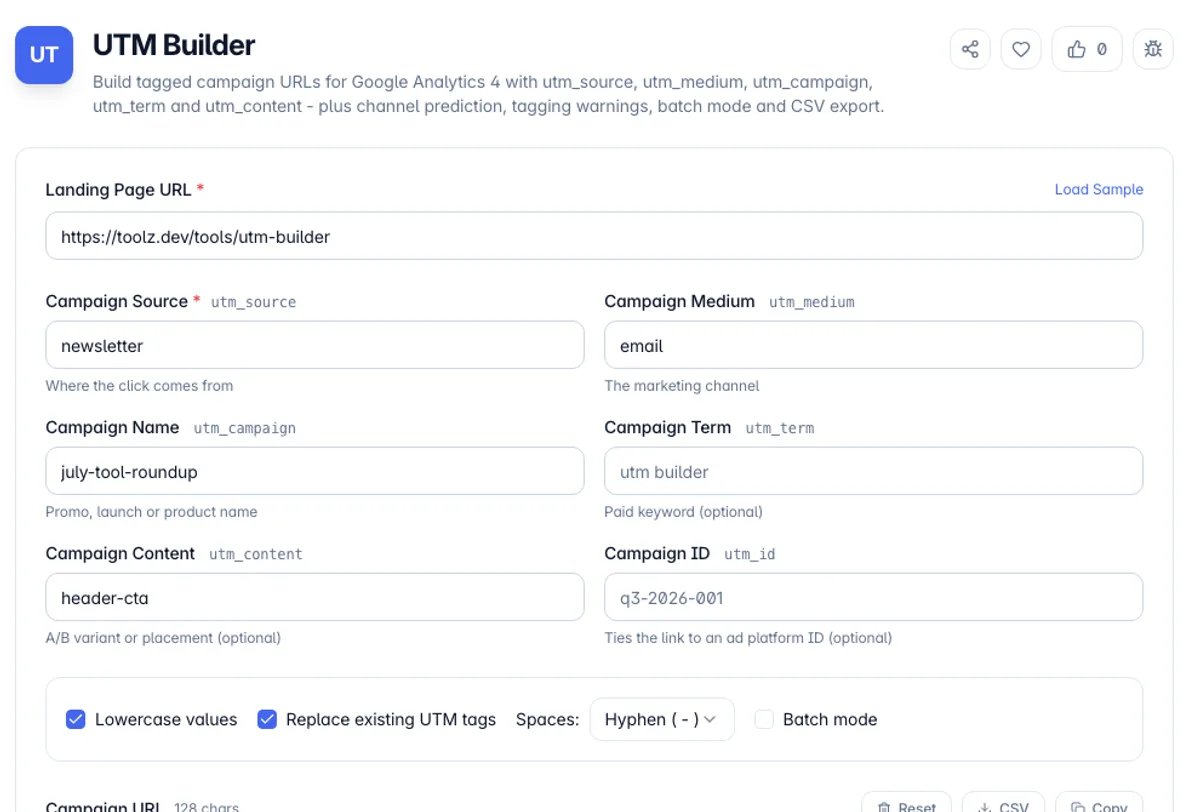
The UTM Builder turns a plain landing page URL into a tagged campaign URL. You enter the destination, fill in utm_source, utm_medium and utm_campaign (plus utm_term, utm_content and utm_id when you need them), and the tool assembles a correctly encoded query string you can paste into an email, an ad, a social post, or a QR code. UTM parameters are ignored by your web server and read by analytics tools, so the page renders exactly as before - only the attribution changes.
Getting the tags right matters more than most people expect. Google Analytics 4 treats values as case-sensitive, so Email and email become two separate mediums in your reports, and a medium GA4 does not recognise - utm_medium=facebook is the classic one - sends the whole campaign into the Unassigned bucket where it is effectively invisible. This tool normalises capitalisation and spaces, then shows you the GA4 default channel group your combination will most likely land in before you ever ship the link.
Everything runs in your browser. The URL, the parameters and the generated links never leave your device, which matters because campaign URLs routinely contain unreleased product names, partner names and pricing pages. Batch mode builds one link per source in a single pass, and the CSV export drops straight into a campaign tracking sheet.
UTM values are case sensitive everywhere it counts, and that is the single biggest cause of messy campaign reports. Google, google and GOOGLE arrive as three separate sources and split one campaign across three rows, so pick lower case and hold to it. Two more worth knowing. If Google Ads auto-tagging is enabled, its gclid parameter already carries the attribution and manual UTM tags on the same links can override it, producing figures that disagree with the Ads console. And UTM parameters are for external traffic only: tagging internal links restarts the session attribution and credits your own site as the source, which is how a campaign ends up attributed to itself. The channel prediction here shows how GA4 will group each combination before you commit to it.
How to use the UTM Builder?
Paste your landing page URL
Enter the page you want people to land on, such as https://example.com/pricing. Existing query parameters and the #fragment are preserved; any old utm_ tags are replaced unless you tell the tool to keep them.
Fill in the campaign parameters
utm_source (where the traffic comes from) is required. Add utm_medium (the marketing channel) and utm_campaign (the campaign name) - GA4 needs all three to report the campaign properly. utm_term and utm_content are optional and used for keywords and A/B variants.
Check the channel and warnings
The tool shows the GA4 default channel group your source and medium will map to, and flags common mistakes such as unrecognised mediums, stray capitals and http:// URLs that may redirect and drop the query string.
Copy the URL - or build a batch
Copy the finished link, or switch on batch mode and paste one source per line to generate a tagged URL for every placement at once, then export the whole set as CSV for your tracking sheet.
Key Features
GA4 Channel Prediction
Shows the default channel group (Email, Paid Search, Organic Social, Referral, Affiliates, Display, Unassigned) your source and medium will fall into, so you catch mis-tagged links before launch instead of after the campaign ends
Tagging Warnings
Flags empty mediums and campaigns, unrecognised medium values, capital letters that split your reports in two, and http:// landing pages whose redirects can strip the query string
Safe URL Assembly
Preserves existing query parameters and fragments, percent-encodes values correctly, and replaces stale utm_ tags on URLs that were already tagged once
Batch Mode
One campaign, many placements - paste "source", "source,medium" or "source,medium,content" per line and get a tagged URL for each, ready to hand to a partner or an agency
Frequently Asked Questions
Related Tools
Query String Parser
Parse a URL query string into structured JSON, or build a query string from a JSON object. Handles repeated keys, bracket arrays, and encoding. 100% client-side.
Slug Generator
Turn any title or text into a clean, SEO-friendly URL slug - with accent transliteration, hyphen or underscore separators, stop-word removal, and batch mode.
URL Parser
Break any URL into its parts - scheme, host, port, path, query, and fragment - and read the query string as a clean, decoded key-value table.
Timestamp Converter
Convert between Unix timestamps and human-readable dates
Comments
0 comments
No comments yet. Be the first to share your thoughts!