What is the Slug Generator?
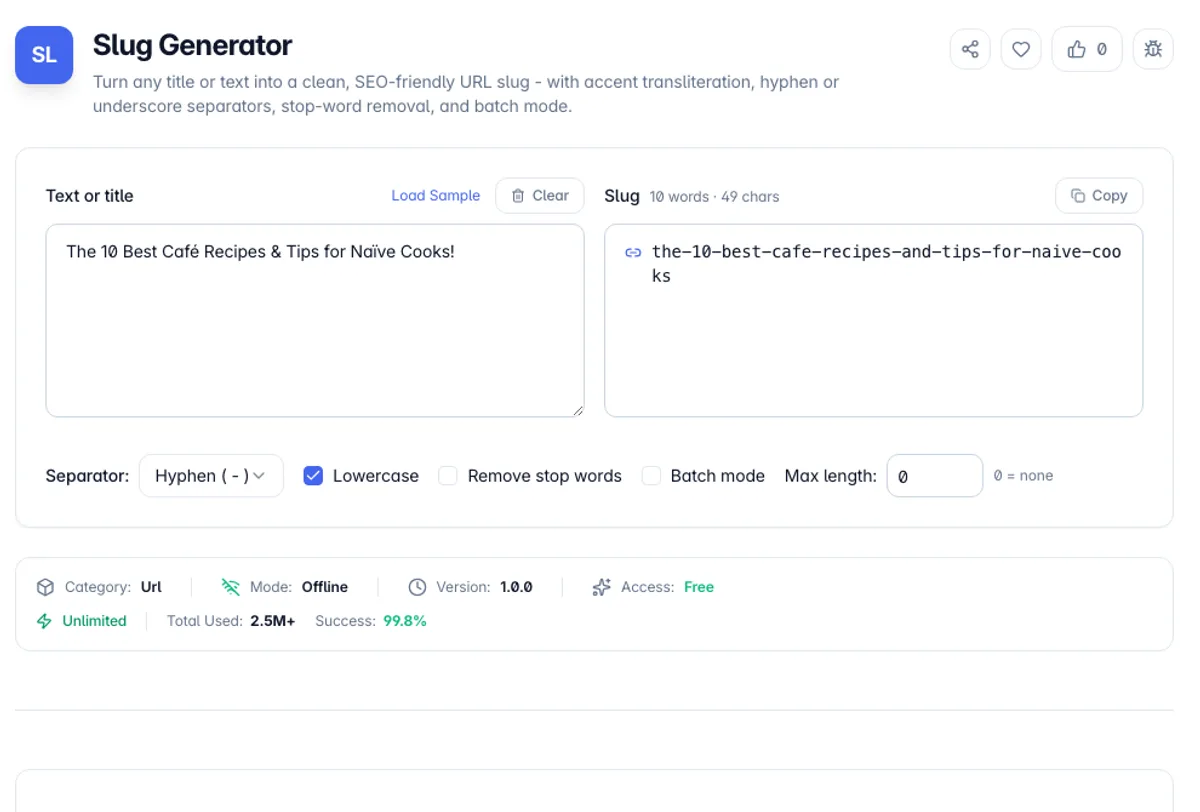
The Slug Generator converts any title, heading, or block of text into a clean, URL-safe slug - the human-readable part of a web address, like "seo-friendly-url-slugs" in /blog/seo-friendly-url-slugs. It lowercases the text, transliterates accented and special characters into plain ASCII, replaces spaces and punctuation with a separator, and collapses the result into a tidy string you can drop straight into a permalink, route, or filename.
A slug generator and a URL slug generator are the same thing under two names: both turn a title into the path segment after the domain. Paste "The 10 Best Café Recipes & Tips for Naïve Cooks!" and the default settings return the-10-best-cafe-recipes-and-tips-for-naive-cooks. The ampersand becomes "and", the accents drop, and the exclamation mark disappears. Tick Remove stop words and it shortens to 10-best-cafe-recipes-tips-naive-cooks, because "the", "and" and "for" are on the stop-word list.
A good slug matters for both search engines and people. Slugs appear in search results, get shared in links, and become the canonical identifier for a page, so they need to be short, descriptive, and free of the characters that break URLs or force ugly percent-encoding. Writing them by hand is tedious and error-prone; a single stray apostrophe or accented vowel can produce a link that looks broken or fails to match your routing rules.
Everything runs 100% in your browser. Paste one title or a whole list, choose your separator and options, and copy the result - nothing is uploaded, and the tool works offline once loaded. Batch mode slugifies every line at once, which is ideal for migrating a content export, generating slugs for a CSV of article titles, or seeding routes for a new project.
Transliteration is lossy by nature, and knowing where it loses helps. Accented Latin maps cleanly, so é becomes e and ü becomes u, at the cost of a distinction that matters in the source language. Scripts with no Latin equivalent have no good answer: Chinese, Arabic and Hindi cannot be reduced to ASCII without either romanising by pronunciation, which needs a dictionary, or dropping the characters entirely. If your audience reads those scripts, a URL-encoded slug in the original script is usually the better choice, since browsers display it correctly and search engines handle it. Stop-word removal shortens slugs and can change meaning, so check the result rather than trusting it. Nothing here guarantees uniqueness: two different titles can produce the same slug, which your application has to resolve.
How to use the Slug Generator?
Enter your text
Type or paste a title into the input box. For batch mode, paste multiple titles - one per line - and each becomes its own slug.
Choose your options
Pick a hyphen or underscore separator, toggle lowercase, optionally remove common stop words, and set a maximum length if your CMS limits slug size.
Get the slug
The slug updates instantly as you type or change options, with a live word and character count so you can keep it concise.
Copy and use it
Copy the slug to your clipboard and paste it into WordPress, your framework route, a filename, or a database seed.
Key Features
Accent Transliteration
Converts accented and European letters to plain ASCII - café becomes cafe, Schön becomes schon, and ß becomes ss - so slugs never need percent-encoding
Hyphen or Underscore Separator
Choose the hyphen (the SEO standard Google treats as a word separator) or underscore for systems that require it
Stop-Word Removal
Optionally strip filler words like "the", "a", "and", and "of" to produce shorter, keyword-focused slugs - without ever emptying the slug entirely
Length Limiting
Truncate long titles to a maximum length at a word boundary, so slugs stay within CMS limits and read cleanly
Frequently Asked Questions
Related Tools
Query String Parser
Parse a URL query string into structured JSON, or build a query string from a JSON object. Handles repeated keys, bracket arrays, and encoding. 100% client-side.
URL Parser
Break any URL into its parts - scheme, host, port, path, query, and fragment - and read the query string as a clean, decoded key-value table.
UTM Builder
Build tagged campaign URLs for Google Analytics 4 with utm_source, utm_medium, utm_campaign, utm_term and utm_content - plus channel prediction, tagging warnings, batch mode and CSV export.
TikTok Video Downloader
Download TikTok videos without watermark. Save videos, music, and cover images from any TikTok link.
Comments
0 comments
No comments yet. Be the first to share your thoughts!