User-agent group 1
User-agent group 2
robots.txt
User-agent: *
Disallow: /admin/
Disallow: /cart
Disallow: /*?sessionid=
Allow: /admin/public/

User-agent: GPTBot
User-agent: ClaudeBot
User-agent: CCBot
Disallow: /

Sitemap: https://example.com/sitemap.xml
Upload this to the root of your domain so it is served at /robots.txt.
Validation
0 errors · 1 warning- Line 10: `Disallow: /` blocks the whole site for "GPTBot, ClaudeBot, CCBot". That is intentional when refusing a specific crawler - just confirm it is the agent you meant.
Test a URL
The longest matching path pattern wins, and Allow beats Disallow on a tie - the same precedence real crawlers use.
Known crawlers
Click Block to add a group that refuses a crawler outright. Compliance is voluntary - this stops cooperative bots, not scrapers.
| Token | What it is | Action |
|---|---|---|
| Googlebot | Google Search's main web crawler. Blocking it removes you from Google over time. | |
| Googlebot-Image | Crawls images for Google Images. Block it to keep photos out of image search. | |
| Bingbot | Microsoft Bing's crawler. Also feeds Bing-powered results in other products. | |
| DuckDuckBot | DuckDuckGo's own crawler for its instant answers and index. | |
| Baiduspider | Baidu's crawler, the dominant search engine in China. | |
| YandexBot | Yandex's crawler, the leading search engine in Russia. | |
| Slurp | Yahoo's legacy crawler. Still used for some Yahoo verticals. | |
| Applebot | Apple's crawler, powering Siri and Spotlight Suggestions. | |
| Twitterbot | Fetches link preview cards for X/Twitter. Blocking it kills your share previews. | |
| facebookexternalhit | Fetches Open Graph previews for Facebook, Messenger, and WhatsApp. | |
| GPTBotAI | OpenAI's crawler that collects public web content used to train its models. | |
| ClaudeBotAI | Anthropic's crawler for gathering training data for Claude. | |
| PerplexityBotAI | Perplexity's crawler, used to index pages its answer engine cites. | |
| CCBotAI | Common Crawl's bot. Its public corpus is a common source of AI training data. | |
| Google-ExtendedAI | Controls whether Google may use your content for Gemini and Vertex AI training. It does not affect Google Search ranking or indexing. | |
| BytespiderAI | ByteDance's crawler, associated with TikTok and its AI products. | |
| anthropic-aiAI | Legacy Anthropic token. Harmless to keep alongside ClaudeBot for older references. |
What is a Robots.txt Generator?
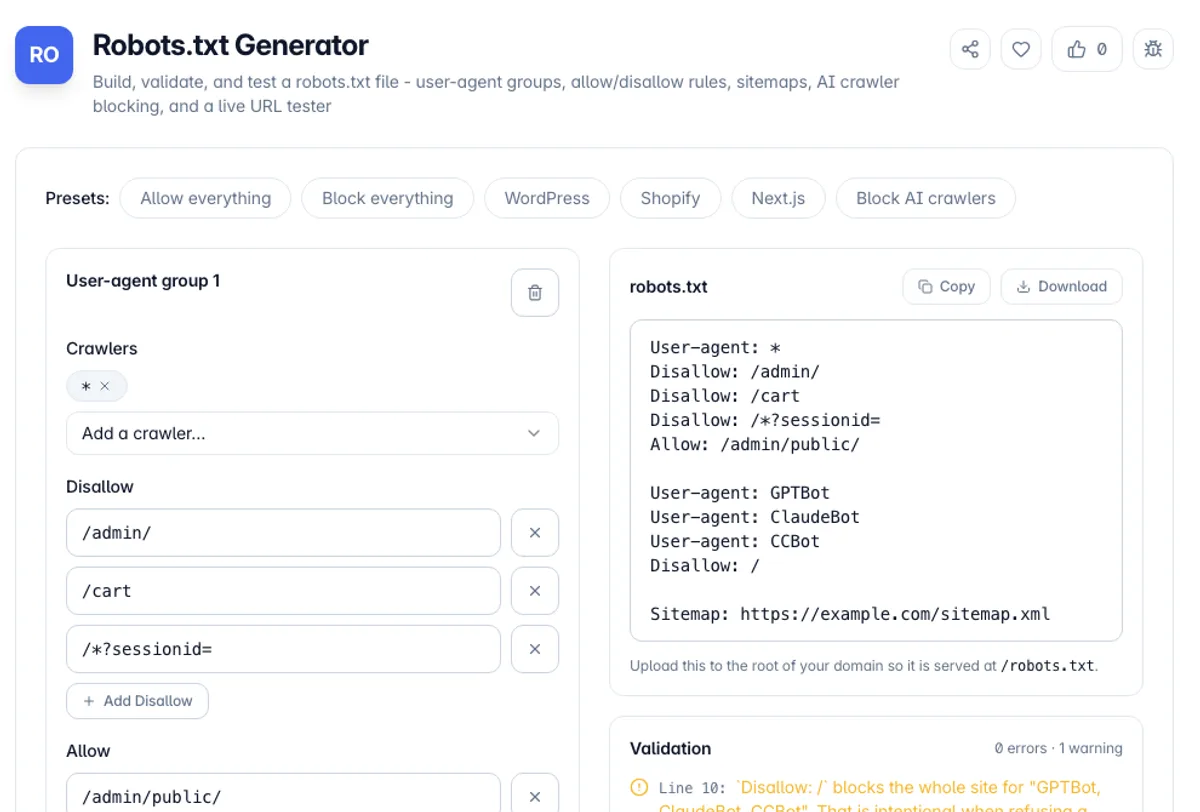
A Robots.txt Generator builds the plain-text file that sits at the root of your domain and tells crawlers which parts of your site they may fetch. The format looks simple - a `User-agent:` line followed by `Allow:` and `Disallow:` rules - but the details bite: rules only apply inside a group, paths must begin with a slash, `*` and `$` behave in specific ways, and a single stray `Disallow: /` under `User-agent: *` can pull an entire site out of Google. This tool builds the file from a structured form so the syntax is correct by construction.
It does three jobs beyond generation. It lints the file it builds and flags the real footguns: relative paths, a bare `Disallow:` that silently means "allow everything", sitemap URLs that are not absolute, a very high Crawl-delay and blanket blocks, and notes when one crawler is split across two groups. It parses an existing robots.txt back into editable groups, so you can paste what is live today and fix it. And it tests a URL against your rules with the same longest-match precedence real crawlers use - the most specific matching pattern wins, Allow beats Disallow on ties, and groups naming the same crawler are combined - so you can prove a page is reachable before you deploy.
As a robots.txt file generator, the page opens on a worked example. The `User-agent: *` group disallows /admin/, /cart and /*?sessionid= and allows /admin/public/, and a second group refuses GPTBot, ClaudeBot and CCBot with `Disallow: /`. Test /admin/public/style.css as Googlebot and the result is Allowed, because `Allow: /admin/public/` is the longest matching rule. Change the path to /admin/settings and it flips to Disallowed by `Disallow: /admin/`. The validator shows one warning, confirming the `Disallow: /` is meant for those three crawlers. This free robots.txt generator needs no signup.
One thing worth stating plainly: robots.txt controls crawling, not indexing, and it is not a security boundary. A blocked URL can still appear in search results if other pages link to it, because Google can index a URL it has never fetched. To keep a page out of the index you need a `noindex` meta tag or an X-Robots-Tag header - which the crawler can only see if it is allowed to fetch the page. And the file is public: anyone can read yours at /robots.txt, so listing a secret directory there advertises it. Use authentication for anything private.
How to use the Robots.txt Generator?
Start from a preset or paste your current file
Pick a preset - Allow everything, Block everything, WordPress, Shopify, Next.js, or Block AI crawlers - to fill the form in one click, or paste your live robots.txt and let the tool parse it back into editable groups.
Build your user-agent groups
Add a group per crawler or set of crawlers, choosing from the known-bot list or typing a token. Give each group its Disallow and Allow paths, and a Crawl-delay if the engine you are targeting honours one.
Add sitemaps and read the validator
Add one or more absolute sitemap URLs. The validator runs on every keystroke and reports errors, warnings and notes, with a line number where one line is at fault. Fix anything red before you ship, and replace the example.com sitemap URL the presets put in.
Test a URL, then copy or download
Enter a path and a user-agent to see Allowed or Disallowed and exactly which rule decided it. When it behaves the way you expect, copy the file or download robots.txt and upload it to your domain root.
Key Features
Real Longest-Match URL Tester
Tests any path against any user-agent using RFC 9309 precedence - the longest matching pattern wins, Allow breaks ties - and names the exact rule that decided it
Built-in Validator
Catches relative paths, empty Disallow and Allow lines, non-absolute sitemap URLs, a Crawl-delay over 30 seconds, and a blanket Disallow: / that would drop your site from search
One-Click Presets
Allow everything, Block everything, WordPress, Shopify, Next.js, and Block AI crawlers each fill the whole form with a sensible, correct starting point
AI Crawler Controls
Block GPTBot, ClaudeBot, PerplexityBot, CCBot, Google-Extended, Bytespider, and anthropic-ai in one click while keeping search engines fully welcome
Frequently Asked Questions
Related Tools
Hreflang Generator
Free hreflang generator for multilingual and multi-region sites - build hreflang tags as HTML link tags, XML sitemap entries, or an HTTP header. Validates codes and x-default. Runs client-side.
htaccess Redirect Generator
Generate Apache .htaccess 301 and 302 redirect rules from a list of old-to-new URLs, plus force-HTTPS and www canonicalization directives, all in the browser.
Domain Search
Check one name across dozens of TLDs at once. RDAP first, WHOIS fallback, and a verdict of available, taken or unknown, never a guess
Maps Scraper
Pull business listings for any search and place: name, address, category, rating, review count, phone and website, deduplicated and exportable as CSV.
Comments
0 comments
No comments yet. Be the first to share your thoughts!