A company, brand, or organization - the classic knowledge-panel schema.
Twitter, LinkedIn, Facebook, etc. - maps to sameAs.
<script type="application/ld+json">
{
  "@context": "https://schema.org",
  "@type": "Organization",
  "name": "Acme Inc.",
  "url": "https://acme.com",
  "logo": "https://acme.com/logo.png",
  "description": "We build tools that make the web faster.",
  "email": "[email protected]",
  "telephone": "+1-555-0100",
  "sameAs": [
    "https://twitter.com/acme",
    "https://www.linkedin.com/company/acme"
  ]
}
</script>What is the Schema Markup Generator?
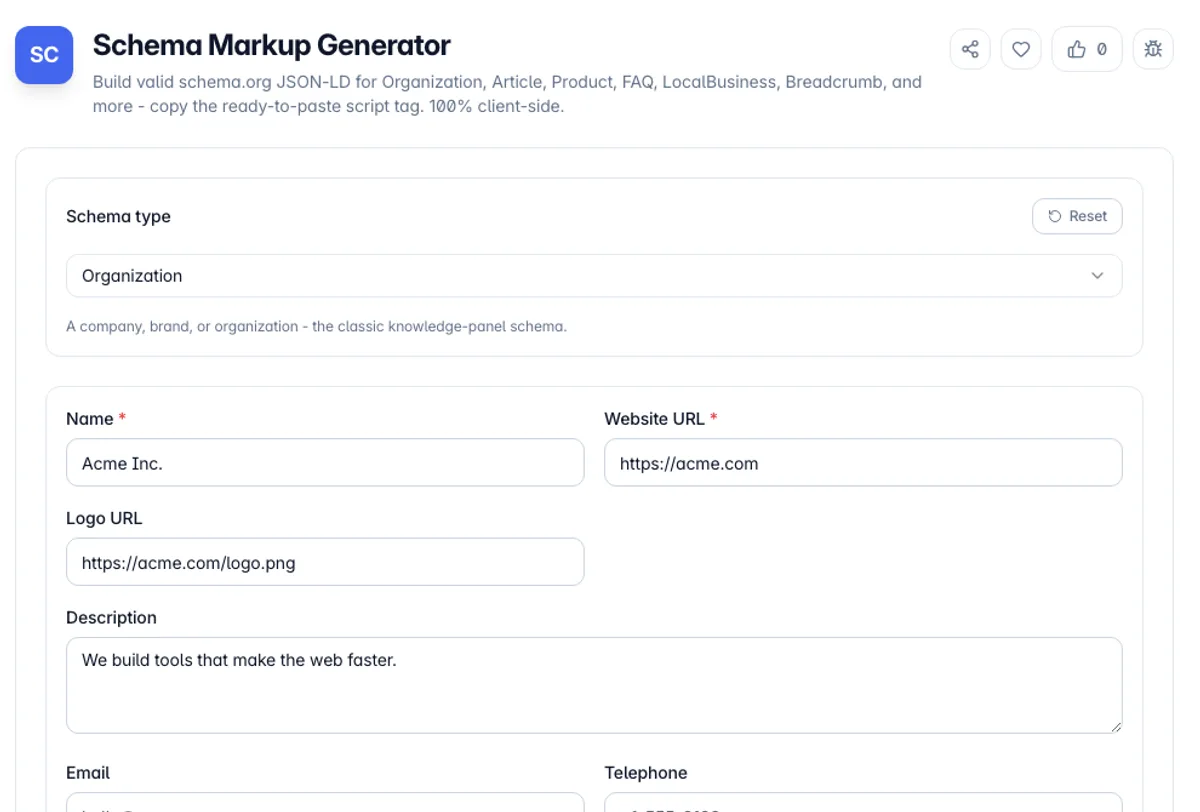
The Schema Markup Generator builds valid schema.org structured data as JSON-LD - the format Google recommends for describing your pages to search engines. You pick a type such as Organization, Article, Product, FAQPage, LocalBusiness, BreadcrumbList, Person, WebSite, or Event, fill in a short form, and the tool assembles a clean, correctly nested JSON-LD object with the right @context, @type, and property names. Structured data is how you tell Google exactly what a page is about, which can make a page eligible for rich results like FAQ accordions, product prices and breadcrumbs.
Writing JSON-LD by hand is error-prone: a misplaced comma, a wrong property name, or a missing nested @type quietly breaks the markup and Google silently ignores it. This generator handles the structure for you. It nests PostalAddress inside LocalBusiness, wraps author and publisher objects inside Article, builds Offer objects for Product and Event, and escapes the characters that would otherwise break an inline script tag. It also flags required fields you have left blank and the properties Google treats as recommended, so you ship markup with the fields rich results expect.
As a FAQ schema generator, pick FAQ Page, type "Do you ship to Canada?" as Question 1 and "Yes, orders over $50 ship free." as its answer, and the output is a FAQPage object whose mainEntity holds one Question with an acceptedAnswer of @type Answer. Leave the second answer empty and the page shows "FAQ #2 is missing an answer." As a product schema generator it works the same way: a Product name of Wireless Headphones and a Price of 99.00 in USD becomes a Product with a nested Offer. The same form makes this a JSON-LD schema generator for nine types in total.
Everything runs client-side. Your content - which may include unpublished product prices, event details, or internal URLs - is never uploaded to a server, and the tool keeps working offline once loaded. When the JSON-LD looks right, copy the complete <script type="application/ld+json"> tag straight into your page <head>, or copy just the JSON to drop into a tag manager or CMS field, then confirm it with Google's Rich Results Test. Pressing Copy checks your daily usage allowance and records the copy with the schema type, never the field values.
How to use the Schema Markup Generator?
Choose a schema type
Select the type that matches your page - Organization, Article, Product, FAQPage, LocalBusiness, BreadcrumbList, Person, WebSite, or Event. The form updates to show the fields for that type.
Fill in the fields
Enter the details. Required fields are marked, and the tool warns you about recommended fields (like image or datePublished) that help you qualify for rich results.
Review the live JSON-LD
The generated JSON-LD updates as you type. Empty fields are dropped automatically, and address, author, publisher, and offer objects are nested correctly.
Copy the script tag
Copy the full <script type="application/ld+json"> block into your page <head>, or copy just the JSON for a tag manager. Validate the result with Google's Rich Results Test.
Key Features
Nine Common Schema Types
Organization, LocalBusiness, WebSite, Article, Product, FAQPage, BreadcrumbList, Person, and Event - the types that power most rich results
Correct Nesting & @type
Builds PostalAddress, Offer, author, publisher, and location sub-objects with the right @type so the markup validates instead of silently failing
Required & Recommended Checks
Flags required fields you left blank and warns about Google-recommended properties like image, datePublished, and logo before you publish
Ready-to-Paste Script Tag
Outputs a complete <script type="application/ld+json"> block with script-safe escaping, plus a JSON-only copy for tag managers and CMS fields
Frequently Asked Questions
Related Tools
Backlink Finder
Find sites in your niche that accept guest posts, using the search footprints those pages leave behind. Deduplicated by domain, with the page that matched.
Content Analyzer
Audit any page for on-page SEO and readability: title, description, headings, alt text, internal links, Flesch score and keyword frequency, with a score out of 100.
Open Graph Preview
Preview how your link will look on Facebook, X, LinkedIn, Slack, and Discord, validate your og: tags, and copy a correct meta block
XML Sitemap Generator
Turn a list of URLs into a valid XML sitemap with lastmod, changefreq, and priority - ready to submit to Google Search Console. 100% client-side.
Comments
0 comments
No comments yet. Be the first to share your thoughts!