What is JSON to YAML Converter?
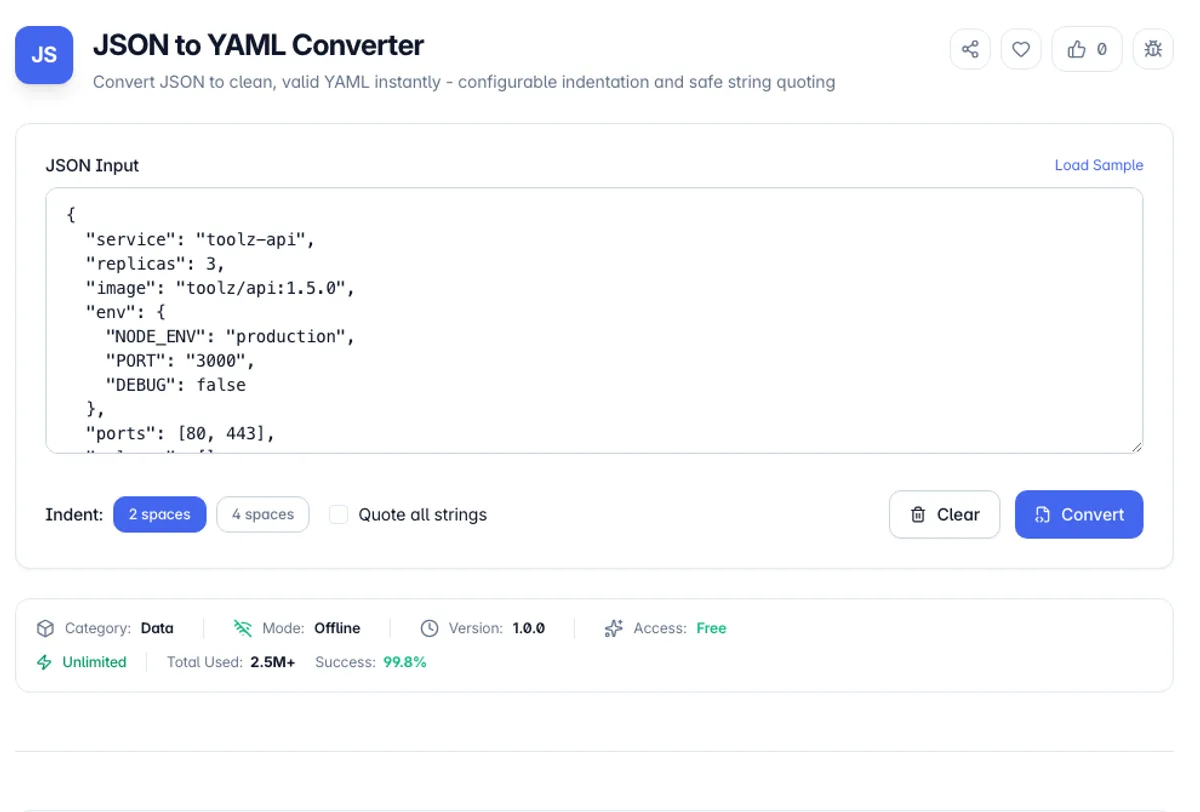
JSON to YAML Converter transforms any JSON document into equivalent, valid YAML. Paste JSON - an API payload, a package manifest, a config export - and get back clean YAML with consistent indentation, correct list syntax, and properly quoted strings, ready to drop into a Kubernetes manifest, Docker Compose file, GitHub Actions workflow, or any other YAML-based configuration.
The conversion is not just a syntax swap. YAML has sharp edges JSON does not: an unquoted "no" becomes the boolean false in many parsers, "3000" silently turns into a number, and version strings like 1.10 get truncated to 1.1. This converter detects the common ambiguous scalars - booleans, null, decimal numbers, YAML 1.1 legacy values like yes/no/on/off, and strings with special characters - and quotes them so your data survives the round trip with types intact.
Here is what this online JSON to YAML converter does with a small Docker Compose style snippet. The input {"name": "web", "ports": ["8080:80"], "debug": "no"} comes out as four lines: name: web, then ports:, then an indented - "8080:80", then debug: "no". The port mapping is quoted because it contains a colon, and "no" is quoted so it stays a string. Nothing is installed: the JSON to YAML converter online runs in the page, so it works the same on a laptop or a phone browser.
Everything happens client-side, in your browser. Configuration files often contain hostnames, internal ports, and secrets, so nothing you paste is uploaded or stored - the converter works offline once loaded. Indentation is configurable (2 or 4 spaces) to match your team's style, and there is an option to quote every string for maximum safety.
Two things about the conversion are worth checking in the output. Strings that look like other types are quoted deliberately, because YAML would otherwise reinterpret them: the JSON string "yes" is a boolean once unquoted under YAML 1.1 rules, and "1.10" becomes the number 1.1. Over-quoting is the safe failure here and under-quoting is the dangerous one. The second is that JSON has no comments to carry across, so a config converted from JSON arrives with none, and anything explanatory has to be written back in by hand. Deeply nested structures stay valid but stop being readable, which is worth remembering when the reason for moving to YAML was readability in the first place: past four or five levels, YAML's indentation is harder to follow than JSON's brackets.
How to use JSON to YAML Converter?
Paste your JSON
Paste any valid JSON document into the input panel - objects, arrays, or nested structures of any depth - or click Load Sample to start from a realistic service config.
Pick your options
Choose 2-space or 4-space indentation to match your project conventions, and optionally enable "Quote all strings" if your YAML consumer is strict about types.
Convert
Click Convert. The JSON is validated first - syntax errors are reported with the parser's exact message so you can fix the offending character quickly.
Copy or download the YAML
Copy the generated YAML to your clipboard or download it as a .yaml file, then paste it into your manifest, workflow, or compose file.
Key Features
Type-Safe Quoting
Strings like "no", "3000", and "1.10" are automatically quoted so they stay strings instead of becoming booleans or numbers in YAML parsers
Configurable Indentation
Output with 2-space or 4-space indentation to match Kubernetes, Ansible, or your team's lint rules
Handles Deep Nesting
Nested objects, arrays of objects, empty arrays ([]) and empty objects ({}) all convert to their correct YAML forms
Instant Validation
Invalid JSON is caught before conversion with the exact parse error, so you never get silently broken YAML
Frequently Asked Questions
Related Tools
JSON Escape / Unescape
Escape and unescape strings for JSON online - handles quotes, backslashes, newlines, tabs, control characters, and \uXXXX Unicode, with optional quote wrapping
JSON Flattener
Flatten nested JSON into single-level dot-notation keys, or unflatten dotted keys back into nested objects and arrays. Lossless round trip. 100% client-side.
JSON Sorter
Sort the keys of a JSON object alphabetically, recursively through nested objects, with optional array sorting. Ascending or descending, minify or pretty. Client-side, no signup.
YAML to JSON Converter
Convert YAML to JSON instantly - anchors, aliases, merge keys, block scalars and multi-document streams supported
Comments
0 comments
No comments yet. Be the first to share your thoughts!