What is the CSV Viewer?
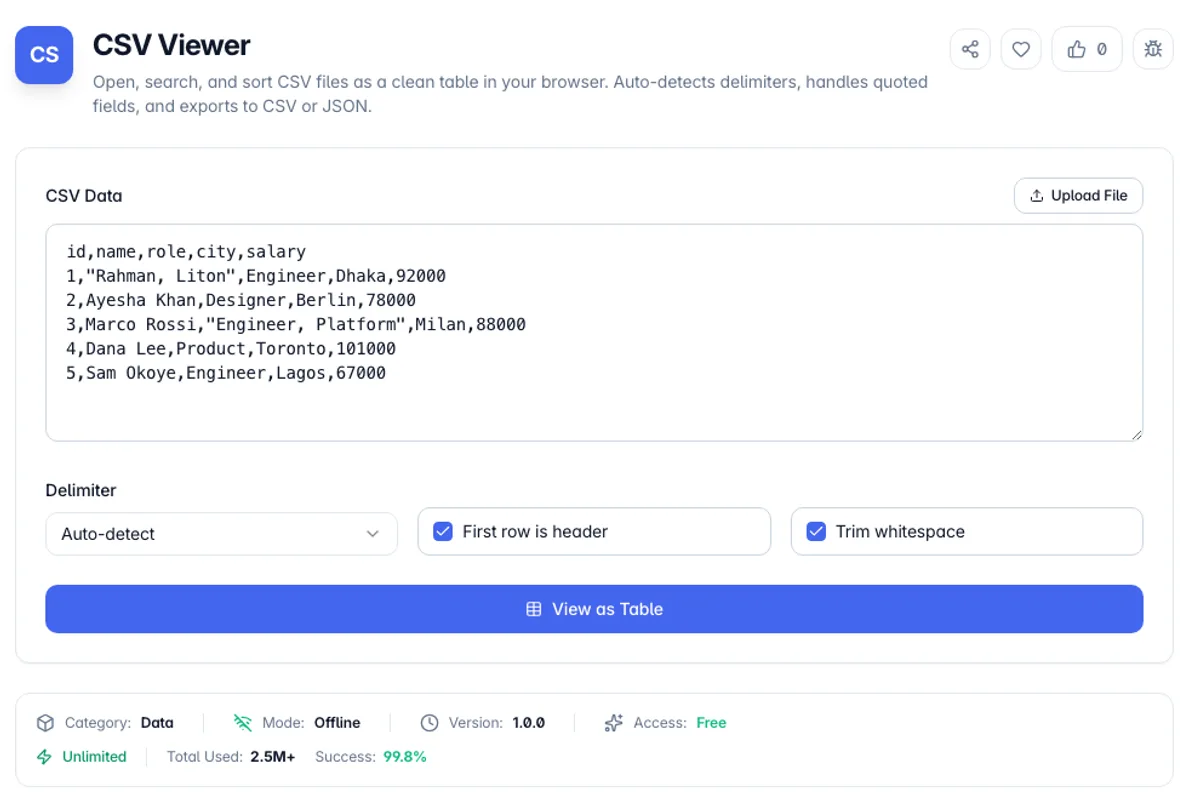
The CSV Viewer turns raw comma-separated text into a readable, sortable table without opening a spreadsheet application. Paste the contents of a file or click Upload File to load it, click View as Table, and the tool parses it, detects the delimiter, reads the header row, and renders every record as a table you can search and sort by column.
CSV looks simple until you meet a real file. Fields wrapped in quotes contain commas. Quotes inside those fields are doubled. Some exports use semicolons because the source locale uses commas as decimal separators. Rows go ragged when an upstream system drops a field. This viewer implements the RFC 4180 quoting rules properly, flags ragged rows and duplicate column names instead of silently mangling them, and lets you switch delimiters when auto-detection guesses wrong.
The built-in sample is a quick way to check any CSV file viewer. Click View as Table and it opens as 5 rows and 5 columns with the delimiter shown as a comma, and the quoted "Rahman, Liton" stays in one cell. Click the salary heading and the rows sort numerically from 67000 to 101000; type engineer in the search box and three rows remain. The same steps work on a large CSV, with one limit: the table draws the first 500 matching rows, while search and sorting cover every row and the CSV and JSON exports include every match.
Everything runs in your browser. The file is read with the FileReader API and parsed in JavaScript - nothing is uploaded, which matters when the CSV holds customer records, payroll data, or an export from a production database. Once the page has loaded, the tool keeps working offline.
CSV is a family of formats rather than one, which is why delimiter detection is the first thing that happens. Comma, semicolon and tab are all in common use, and European locales frequently use semicolons because the comma is the decimal separator. Quoted fields follow RFC 4180, so a comma inside quotes is data rather than a separator and a doubled quote is a literal one. The data quality warnings exist for the cases that are legal but usually wrong: rows with more or fewer fields than the header, which normally means an unescaped quote further up the file, and duplicate column names. Every value stays text, so leading zeros that a spreadsheet would have eaten remain visible. Files are read in the browser, so size is bounded by available memory rather than by an upload limit; very large exports are better sampled than opened whole.
How to use the CSV Viewer?
Load your CSV
Paste CSV text into the input box, or click Upload File to open a .csv, .tsv, or .txt file from your computer, then click View as Table. The file is read locally and never uploaded.
Check the parse settings
Delimiter is auto-detected from the first ten lines. Override it if needed, and toggle "First row is header" and "Trim whitespace" to match your file.
Search and sort the table
Type in the search box to filter rows across every column, or click a column heading to sort it. Numeric columns sort numerically, not alphabetically.
Export the result
Copy the table as JSON, download it as a normalised CSV with proper quoting, or download a JSON file for use in an API or script.
Key Features
Automatic Delimiter Detection
Scores commas, semicolons, tabs, and pipes across the first ten lines and picks the one that produces a consistent column count - so European semicolon exports and TSV files open correctly
RFC 4180 Quoted Field Support
Handles quoted fields containing delimiters, escaped double quotes, and newlines inside cells - the cases that break naive split(",") parsers
Search and Column Sorting
Filter rows with a live case-insensitive search across all columns, and sort any column ascending or descending with numeric-aware comparison
Data Quality Warnings
Flags ragged rows that do not match the header width and duplicate column names, so you find structural problems before they hit your database import
Frequently Asked Questions
Related Tools
JSON to CSV Converter
Convert JSON to CSV online. Turns an array of objects into a spreadsheet-ready file, flattens nested objects, and escapes fields per RFC 4180. Client-side, no signup.
JSON to PHP Array
Convert JSON into a PHP array literal. Choose short [] or array() syntax, indentation, and an optional variable assignment, then copy the result. Runs client-side.
CSV Diff Checker
Compare two CSV files and see which rows were added, removed, or changed, down to the exact cell. Match rows by a key column or by position. Runs client-side.
Pace Calculator
Calculate running pace, finish time, or distance from any two values, with speed and per-kilometre or per-mile splits.
Comments
0 comments
No comments yet. Be the first to share your thoughts!