What is XML to JSON Converter?
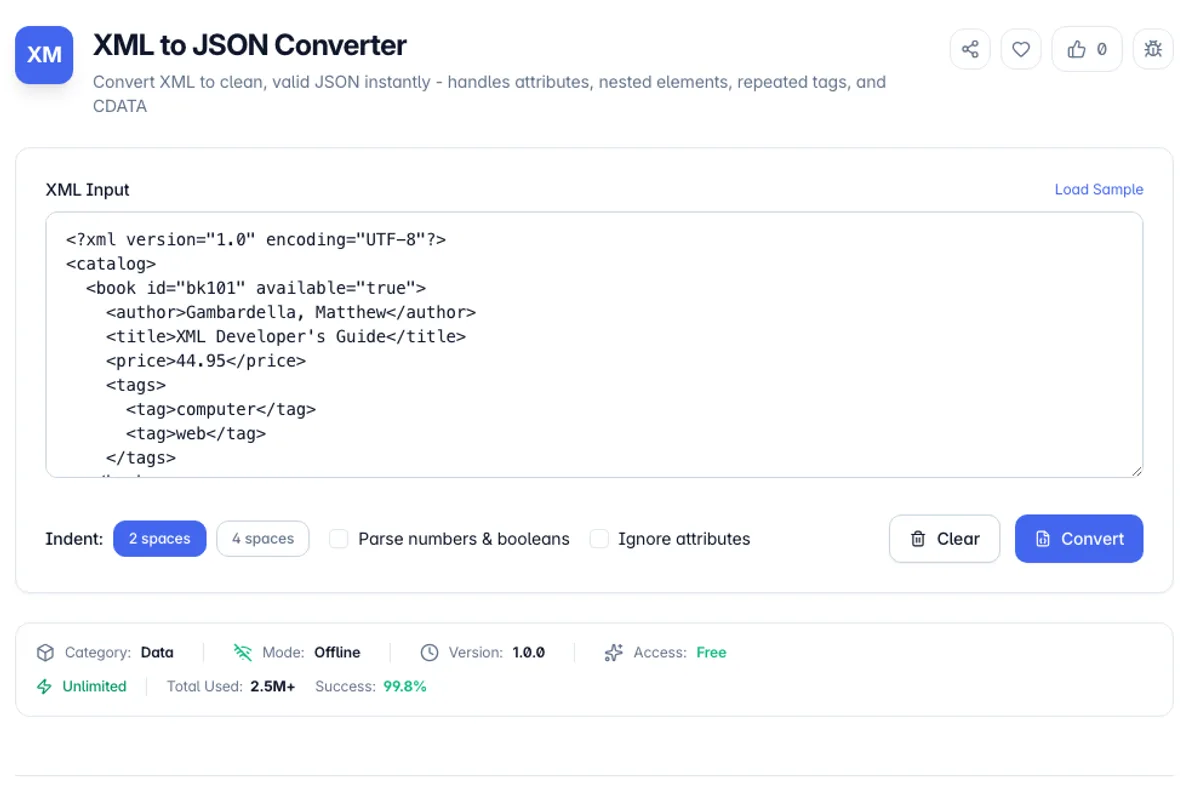
XML to JSON Converter transforms any XML document into equivalent, well-formed JSON. Paste an XML payload - a SOAP response, an RSS feed, a config file, an API export - and get back clean, indented JSON that maps elements to keys, repeated tags to arrays, and attributes to prefixed properties, ready to use in JavaScript, a REST client, or a data pipeline.
XML and JSON model data differently, and a naive conversion loses information. XML has attributes, which JSON has no direct equivalent for; it allows an element to hold both attributes and text; and it distinguishes a single child from a list only by repetition. This converter handles each case deliberately: attributes become keys with an @ prefix, mixed content keeps its text under a #text key, and any tag that appears more than once collapses into a JSON array so your structure stays faithful to the source.
Everything runs 100% in your browser using a dependency-free parser - no DOMParser, no server round trip. XML documents frequently carry internal identifiers, customer records, or integration payloads, so nothing you paste is uploaded or stored. The converter works offline once loaded, and entities are decoded automatically. Two options let you parse numeric and boolean text into real types and ignore attributes when you only need the element data.
The quickest way to check any online XML to JSON converter is a small record. Paste <order id="42"><item>pen</item><item>ink</item><note>gift</note></order> and click Convert, and you get {"order": {"@id": "42", "item": ["pen", "ink"], "note": "gift"}}. The attribute gains an @ prefix, the two item tags become an array, and the single note stays a plain string. Tick Parse numbers & booleans and the id comes out as the number 42 instead of the string "42".
XML and JSON model data differently, so any conversion has to make choices, and knowing which ones were made saves confusion later. Attributes and child elements share a namespace in JSON but not in XML, so attributes are prefixed to keep them distinct. Repeated elements become arrays, but a single occurrence is ambiguous by nature: XML cannot say whether one item is a list of one or a plain value, which is why a document that usually has several entries can convert differently when it happens to have one. Element order is preserved within arrays and lost between differently named siblings, since JSON objects are unordered by specification. Comments and processing instructions are dropped. Namespaces are kept as literal prefixes rather than resolved.
How to use XML to JSON Converter?
Paste your XML
Paste any well-formed XML document into the input panel - with or without an XML declaration - or click Load Sample to start from a realistic catalog example with attributes and nested lists.
Choose your options
Pick 2-space or 4-space indentation, decide whether attributes are included, and optionally enable type parsing to turn "44.95" and "true" into a real number and boolean.
Convert
Click Convert. The XML is parsed and validated first - malformed markup like a mismatched or unclosed tag is reported with a clear message so you can fix it.
Copy or download the JSON
Copy the generated JSON to your clipboard or download it as a .json file, then drop it into your code, request body, or data store.
Key Features
Attribute Handling
XML attributes are preserved as JSON keys with an @ prefix, so no data is lost in the conversion
Smart Array Detection
Repeated child elements automatically become a JSON array, while a single occurrence stays a plain object - matching the real structure
CDATA and Entity Support
CDATA blocks are taken verbatim and standard plus numeric entities (&, é) are decoded correctly into their characters
Optional Type Parsing
Turn numeric and boolean text like "3.14" or "false" into real JSON numbers and booleans, or keep everything as strings - your choice
Frequently Asked Questions
Related Tools
CSV to JSON Converter
Convert CSV to JSON online. Parses quoted fields and any delimiter, infers numbers and booleans, and outputs an array of objects. Client-side, no signup.
CSV to XML Converter
Convert CSV data into well-formed XML in the browser. Each row becomes an element or a set of attributes, with delimiter auto-detection, custom element names, and proper escaping.
JSON to XML
Convert JSON to well-formed XML instantly. Map object keys to elements, @-prefixed keys to attributes and #text to content, expand arrays into repeated tags, and export minified or pretty-printed XML. 100% client-side.
XML Formatter
Format, beautify, minify, and validate XML online - preserves comments, CDATA, and attribute order, with clear error reporting
Comments
0 comments
No comments yet. Be the first to share your thoughts!