What is YAML to JSON Converter?
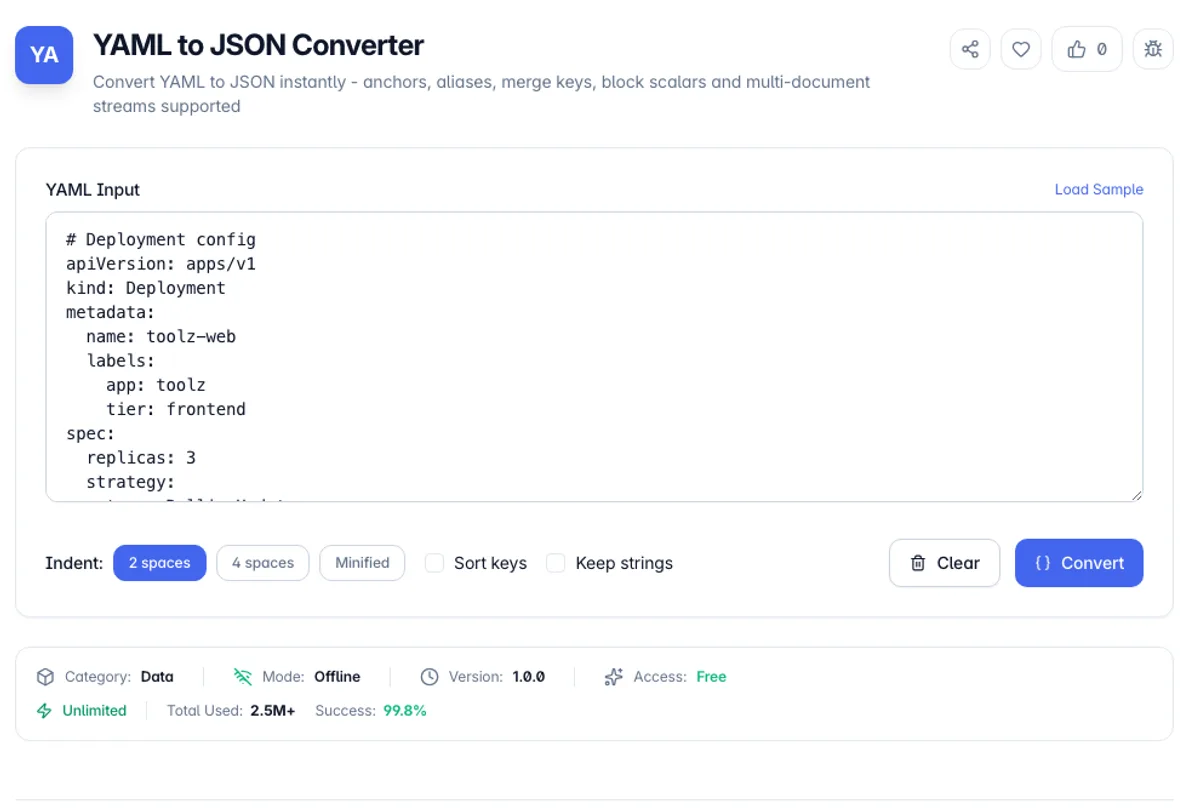
YAML to JSON Converter parses a YAML document and emits the equivalent JSON. Paste a Kubernetes manifest, a Docker Compose file, a GitHub Actions workflow, or an Ansible playbook, and you get back formatted JSON with the same structure - mappings become objects, sequences become arrays, and scalars are resolved to strings, numbers, booleans, or null according to the YAML core schema.
The parser handles the parts of YAML that trip up naive converters. Anchors and aliases are resolved, so a `*defaults` reference expands into the value it points at. Merge keys (`<<: *base`) are flattened into the target mapping, with explicit keys taking precedence as the spec requires. Literal (`|`) and folded (`>`) block scalars keep or fold their newlines correctly, including the strip and keep chomping indicators. Multi-document streams separated by `---` come out as a JSON array of documents.
A short Compose-style file shows what this YAML to JSON converter online does with shared blocks. Given base: &base with image: node:20 and restart: always under it, then web: with <<: *base and restart: "no", the output has two objects. base keeps both keys, and web becomes {"image": "node:20", "restart": "no"}: the merge copied image across, and the key written in web won over the merged restart. The quoted "no" stays a string, and so would an unquoted no, because this converter follows YAML 1.2 rules.
Everything runs in your browser. Config files routinely carry internal hostnames, cluster names, image registries, and occasionally a secret someone forgot to move into a vault, so nothing you paste is uploaded, logged, or stored. You can also sort keys alphabetically for easier diffing, choose 2-space, 4-space, or minified output, and keep every plain scalar as a string when your downstream consumer is strict about types.
The conversion resolves the parts of YAML that JSON has no equivalent for, and it is worth knowing what happens to each. Anchors and aliases are expanded, so a block referenced in five places becomes five copies in the JSON rather than five references, and the output can be substantially larger than the input. Merge keys are applied and disappear. Comments are dropped entirely, since JSON has nowhere to put them. Multi-document streams separated by three dashes become an array, because JSON has no concept of several documents in one file. Dates are the one to watch: YAML parses an unquoted date into a timestamp type, and JSON has no date type, so it arrives as a string whose exact format depends on how it was written.
How to use YAML to JSON Converter?
Paste your YAML
Paste any YAML document into the input panel - a manifest, a compose file, a CI pipeline, or an application config. Click Load Sample to start from a realistic Kubernetes Deployment.
Choose your output options
Pick 2-space, 4-space, or minified JSON. Enable Sort keys for diff-friendly output, or Keep strings when you want ports and version numbers to stay text instead of becoming numbers.
Convert
Click Convert. If the YAML has a syntax problem - a tab used for indentation, an unclosed quote, an alias with no matching anchor - the error is reported with the exact line number.
Copy or download the JSON
Copy the result to your clipboard or download it as a .json file, ready to feed into an API client, a test fixture, or a script.
Key Features
Anchors, Aliases, and Merge Keys
Resolves &anchor definitions, *alias references, and << merge keys so shared config blocks expand into complete JSON objects
Block Scalar Support
Literal (|) and folded (>) blocks convert correctly, including explicit indentation digits and the strip (-) and keep (+) chomping indicators
Multi-Document Streams
YAML files split by --- into several documents, common in Kubernetes, are returned as a JSON array with one entry per document
Line-Accurate Errors
Syntax problems report the exact source line - tabs used as indentation, unterminated quotes, bad indentation, or unknown aliases
Frequently Asked Questions
Related Tools
JSON Escape / Unescape
Escape and unescape strings for JSON online - handles quotes, backslashes, newlines, tabs, control characters, and \uXXXX Unicode, with optional quote wrapping
JSON to TOML Converter
Convert JSON to TOML 1.0. Objects become tables, arrays of objects become arrays of tables, and everything is rendered inline where TOML expects it.
JSON to YAML Converter
Convert JSON to clean, valid YAML instantly - configurable indentation and safe string quoting
JSON Diff Checker
Compare two JSON documents structurally and see added, removed, and changed keys with exact paths
Comments
0 comments
No comments yet. Be the first to share your thoughts!