What is a Number to Words Converter?
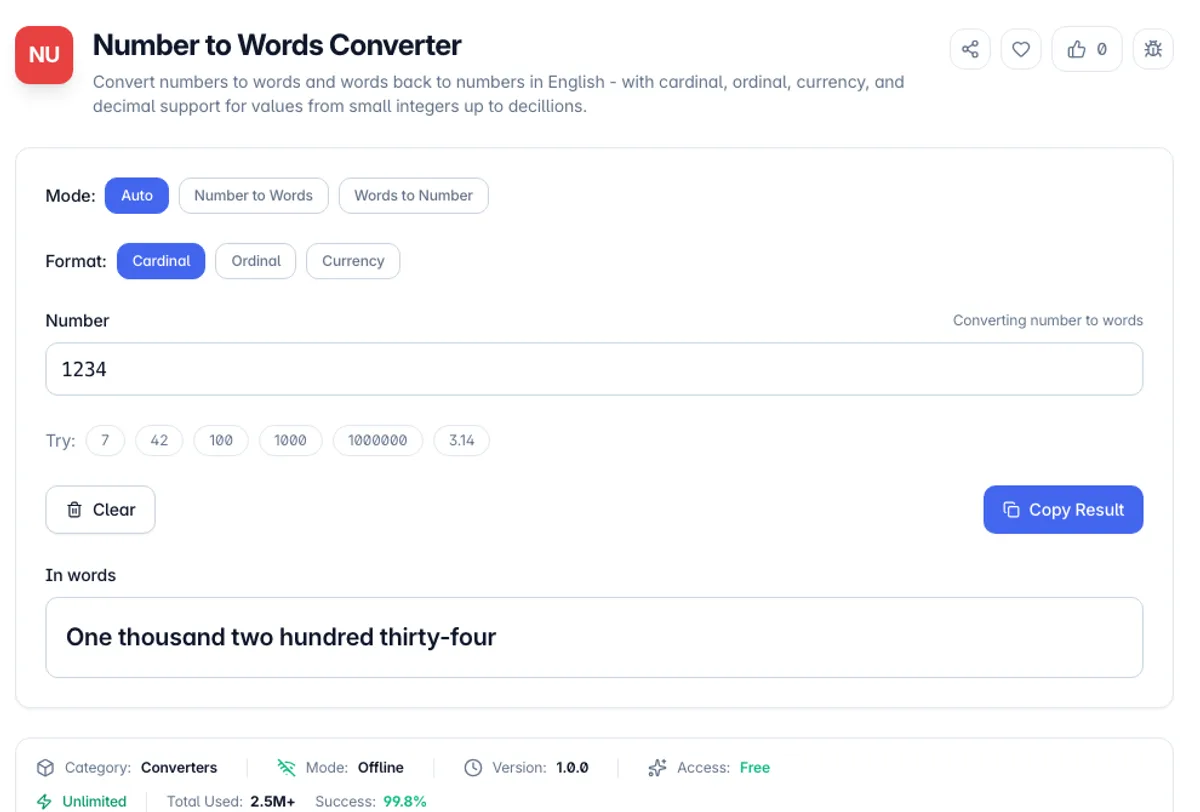
A Number to Words Converter turns a numeric value like 1,234 into its written English form, "one thousand two hundred thirty-four", and reads written numbers back into digits. It handles the everyday need to spell an amount out in full - on a cheque, an invoice, a legal document, or a form - where the words carry the same value as the figures and remove any ambiguity about what was meant.
English number names follow the short scale used across the US and modern UK: groups of three digits are named units, thousand, million, billion, trillion, and on up through quadrillion, quintillion, and beyond. Within each group the tool applies the familiar rules - hyphenating compound tens like twenty-one, inserting "hundred" for the leading digit, and never adding an "and" between the hundreds and the tens in American style. Because the integer is processed digit by digit rather than as a floating-point number, very large whole numbers are spelled exactly, past the point where ordinary number types lose precision.
Beyond plain cardinals, the converter produces ordinals (first, second, twenty-third), currency phrasing (one hundred dollars and fifty cents), and decimals read out digit by digit (three point one four). Everything runs client-side, so nothing you type is uploaded, results appear as you type, and the tool keeps working offline once loaded.
A worked example shows what the number to words converter returns. Type $4,850.75 with Format set to Currency and the In words box reads "Four thousand eight hundred fifty dollars and seventy-five cents"; the dollar sign and comma are stripped first. Switch to Cardinal and the same input becomes "Four thousand eight hundred fifty point seven five", and 4850 with Ordinal gives "Four thousand eight hundred fiftieth". Because this online number to words converter reads the digit string, 9007199254740993, just past the largest integer a JavaScript number stores exactly, is spelled out down to its final "nine hundred ninety-three".
English has two systems for the large names, and they disagree from a billion upwards. The short scale, used in the United States and now standard in British usage, makes a billion a thousand million. The long scale, still used across much of continental Europe, makes it a million million, so the same word differs by a factor of a thousand. Short scale is used here. Two smaller conventions worth noting: British English inserts "and" before the final part, giving one hundred and one where American English gives one hundred one, and the hyphenation of compound numbers such as twenty-one is standard in both. Currency mode names the minor unit rather than reading the decimal digit by digit, since cheques and contracts are written that way.
How to use the Number to Words Converter?
Enter a number or words
Type a number such as 2024 to spell it out, or type words such as "two thousand twenty four" to convert them back to digits. The tool detects which direction you mean.
Choose a format
When spelling a number, pick cardinal (one, two, three), ordinal (first, second, third), or currency (dollars and cents) to match your document.
Read the instant result
The written form appears immediately, with commas and separators in the input handled automatically and decimals read out digit by digit.
Copy the output
Copy the result with one click to paste it into a cheque, invoice, contract, or spreadsheet.
Key Features
Two-way conversion
Spell a number into words or parse words back into a number from the same field. The tool auto-detects the direction and lets you force either one.
Cardinal, ordinal, and currency
Produce plain cardinals (one, two, three), ordinals (first, twenty-third), or currency phrasing (one hundred dollars and fifty cents) to fit the document you are filling in.
Exact spelling of huge numbers
The integer part is handled as a string, so numbers well past the usual precision limit are spelled correctly, all the way up through quadrillions, quintillions, and decillions.
Decimals and negatives
Decimal values are read digit by digit after "point", and negative values are prefixed with "negative", matching how people say and write them.
Frequently Asked Questions
Related Tools
NATO Phonetic Alphabet Translator
Translate text into the NATO phonetic alphabet (Alfa, Bravo, Charlie) and decode code words back to letters
Number Base Converter
Convert integers between binary, octal, decimal, hexadecimal, and any base from 2 to 36 with exact BigInt precision and live bit and byte counts
Roman Numeral Converter
Convert numbers to Roman numerals and Roman numerals back to numbers, with instant validation, a symbol breakdown, and full support for the standard 1 to 3999 range.
Scientific Notation Converter
Convert numbers between scientific notation, E-notation, engineering notation, and plain decimal with exact digit-by-digit precision, plus order of magnitude and significant-figure rounding.
Comments
0 comments
No comments yet. Be the first to share your thoughts!