What is a Roman Numeral Converter?
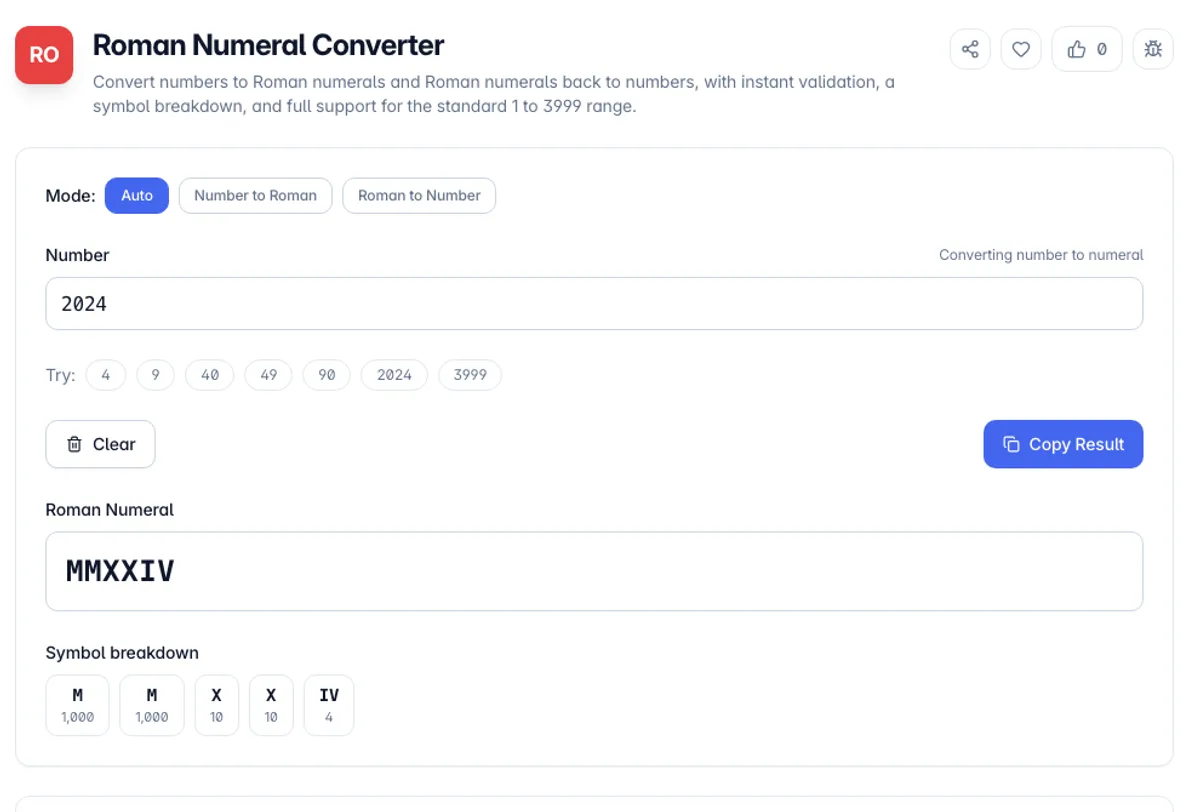
A Roman Numeral Converter translates between the Arabic numbers we use every day and the letter-based numerals of ancient Rome. Roman numerals build values from seven symbols - I, V, X, L, C, D, and M - combined by addition and, in a handful of cases, subtraction. This tool converts a number such as 2024 into MMXXIV, and reads a numeral such as MCMLXXXIV back as 1984, in both directions from a single box.
As a number to roman numeral converter, type 1987 and the result is MCMLXXXVII, with the Symbol breakdown listing M, CM, L, X, X, X, V, I and I. It works just as well as a roman numeral to number converter: type mcmxciv in lower case and Auto mode reads it as 1994, with Normalized: MCMXCIV underneath. Type IC and it refuses, with the message "IC" is not a valid standard numeral. Did you mean XCIX?
The system is additive at heart: symbols are written from largest to smallest and summed, so XVII is 10 + 5 + 1 + 1 = 17. The wrinkle is subtractive notation, where a smaller symbol placed before a larger one is subtracted rather than added - IV is 4, not 6, and CM is 900. Standard modern usage allows only six subtractive pairs (IV, IX, XL, XC, CD, CM) and never repeats a symbol more than three times, which is why 4 is IV and not IIII.
This converter enforces those rules in both directions. Encoding always produces the canonical spelling, and decoding validates the input by round-tripping it: a numeral is accepted only if it is exactly the standard spelling of its own value, so malformed strings like IIII, VX, or IC are caught and corrected. Because there is no Roman symbol for zero and no plain-ASCII symbol for 5000, the tool works over the conventional 1 to 3999 range, and it all runs in your browser with nothing uploaded.
The 3,999 ceiling is not arbitrary. Roman numerals have no symbol above M for a thousand, so larger values were written with a vinculum, an overline multiplying the numeral by a thousand, and that notation has no plain-text form. There is also no zero and no way to write a negative or a fraction in the standard system, which is a large part of why positional arithmetic replaced it. Validation is strict because the subtractive rules are narrower than people remember: only I, X and C subtract, only from the next two higher symbols, so IX is one less than ten and IL is not forty-nine. Repetition is capped at three, which is why forty is XL and not XXXX, though clock faces have used IIII for centuries.
How to use the Roman Numeral Converter?
Enter a number or a numeral
Type an Arabic number such as 2024 to get Roman numerals, or paste a numeral such as MMXXIV to decode it. The tool detects which you mean and can be switched manually.
Read the instant result
The conversion appears as you type. Encoding gives the canonical numeral; decoding gives the number and shows the normalized spelling so you can confirm the input was valid.
Check the symbol breakdown
See how the numeral splits into its additive parts - MCMXCIV as M + CM + XC + IV - which makes the subtractive pairs easy to understand and verify.
Copy or use a quick value
Click Copy Result, or tap one of the Try buttons, 4, 9, 40, 49, 90, 2024 and 3999, to see the rules in action.
Key Features
Two-way conversion
Encode numbers to numerals and decode numerals to numbers from the same input. Encoding always yields the canonical form, and decoding round-trips it to guarantee the two agree.
Strict validation
Malformed numerals such as IIII, VX, or IC are rejected with a message that suggests the correct spelling, because a valid numeral must equal the canonical spelling of its own value.
Symbol breakdown
Every numeral is shown split into its additive components, so you can see exactly why MCMXCIV is 1994 and how each subtractive pair contributes.
Automatic direction detection
Digits are treated as a number to encode; a string of I, V, X, L, C, D, and M is treated as a numeral to decode. A manual switch is always available.
Frequently Asked Questions
Related Tools
NATO Phonetic Alphabet Translator
Translate text into the NATO phonetic alphabet (Alfa, Bravo, Charlie) and decode code words back to letters
Number Base Converter
Convert integers between binary, octal, decimal, hexadecimal, and any base from 2 to 36 with exact BigInt precision and live bit and byte counts
Number to Words Converter
Convert numbers to words and words back to numbers in English - with cardinal, ordinal, currency, and decimal support for values from small integers up to decillions.
Unit Converter
Convert length, weight, temperature, area, volume, speed, time, data, pressure, energy, and angle units instantly with exact conversion factors
Comments
0 comments
No comments yet. Be the first to share your thoughts!