Meeting planner - the same instant in every zone
Enter a valid date and time to build the planner.
What is a Time Zone Converter?
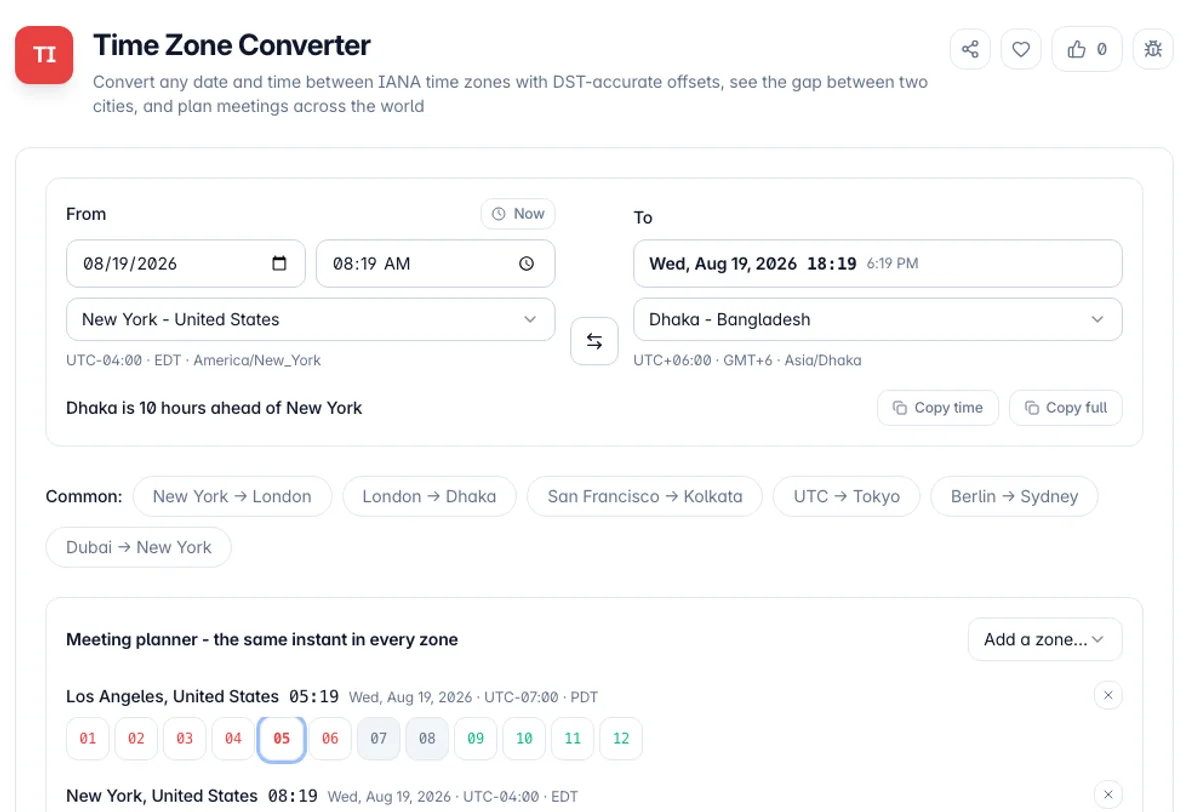
A Time Zone Converter takes a wall-clock reading in one place - 9:00 AM on 12 March in New York - and tells you what the clock says at that same instant somewhere else. It is not simple arithmetic, because the gap between two zones is not a constant. New York is five hours behind London for most of the year and four hours behind for part of it, and for two weeks in spring the gap is four hours because the United States changes its clocks before Europe does.
Conversions inside the United States are simpler. As an EST to CST time zone converter it shows Chicago one hour behind New York, and because Eastern and Central time change their clocks on the same dates, that one-hour gap holds through the year. Used as an Eastern and Central time zone converter for meeting planning, add Chicago to the planner strip next to New York, so a 9:00 AM Central stand-up reads as 10:00 AM Eastern at a glance. Pacific time runs three hours behind Eastern, and UTC is four or five hours ahead of Eastern depending on daylight saving.
This converter resolves every offset through the IANA time zone database that ships with your browser, evaluated at the specific instant you entered. That means daylight saving transitions, half-hour and quarter-hour offsets like India (UTC+05:30) and Nepal (UTC+05:45), and countries that have changed their rules are all handled by the same code path - nothing is hardcoded and nothing goes stale.
Alongside the conversion you get each zone's UTC offset and abbreviation for that date, the signed difference between the two, and a meeting-planner strip that lays the same instant across several zones at once so you can see which hour lands inside everybody's working day. Everything runs in your browser: no dates are uploaded, nothing is logged, and the tool keeps working offline once the page has loaded.
Time zones are political rather than geographic, and that is what makes them hard. Offsets change by government decree, sometimes with only weeks of notice, which is why the IANA database is updated several times a year and why any tool that hardcodes offsets eventually becomes wrong. Daylight saving is applied per instant rather than per zone here, which matters because the answer depends on the date you are converting, not on today: a meeting in March can land in a different offset than the same clock time in January, and the northern and southern hemispheres shift in opposite directions. Abbreviations are worse than useless for precision, since CST means three different things depending on whether you are in Chicago, Havana or Shanghai. Prefer the IANA zone name.
How to use the Time Zone Converter?
Pick the source zone, date, and time
Choose the city you are converting from, then enter the date and the 24-hour time as it reads on the clock there. Press "Now" to load the current moment instead of typing it.
Pick the target zone
Choose the city you want the answer in. The converted date and time appear immediately, along with the UTC offset and zone abbreviation that apply on that specific date.
Read the offsets and the gap
The panel shows each zone's offset from UTC and the signed difference between them - for example "Dhaka is 10 hours ahead of New York". Use the swap button to reverse the direction.
Plan a meeting and copy the result
Add zones to the planner strip to see the same instant in every one, with working hours shaded. Copy just the converted time or the full expression to paste into a calendar invite or a message.
Key Features
DST handled per instant, not per zone
Offsets are resolved for the exact date you enter, so a March meeting and a July meeting between the same two cities can correctly produce different gaps. No hardcoded offset tables to go stale.
50+ curated IANA zones
The cities people actually schedule around, grouped by region and labelled with their country, with the full IANA identifier shown so you can paste it straight into code.
Meeting planner strip
One row per zone, one cell per hour around your instant, with working hours shaded and next-day or previous-day cells marked. Find the hour that works for everyone without doing the arithmetic.
Odd offsets supported
India at UTC+05:30, Nepal at UTC+05:45, Adelaide at UTC+09:30, Chatham at UTC+12:45 - half-hour and quarter-hour zones are as ordinary here as whole-hour ones.
Frequently Asked Questions
Related Tools
Unit Converter
Convert length, weight, temperature, area, volume, speed, time, data, pressure, energy, and angle units instantly with exact conversion factors
Image to Base64 Converter
Convert images to Base64 data URIs and decode Base64 back to images.
JSON to TOML Converter
Convert JSON to TOML 1.0. Objects become tables, arrays of objects become arrays of tables, and everything is rendered inline where TOML expects it.
XML Sitemap Generator
Turn a list of URLs into a valid XML sitemap with lastmod, changefreq, and priority - ready to submit to Google Search Console. 100% client-side.
Comments
0 comments
No comments yet. Be the first to share your thoughts!